Read every review.
Find the gap.
See what customers love, what they complain about, and the gap competitors leave open. From public reviews, in about 20 minutes.
By Paras · Updated June 30, 2026
What fifty reviews actually said.
We audited five dental practices in one city. Instead of reading everything, we pulled each one’s ten lowest rated reviews, about fifty in all, so the problems would surface fast. The same complaints kept coming up.
Even the one star reviews praise the dentist. People like whoever treats them and distrust the front office. Everything that goes wrong happens around the care, not during it.
“a good doctor, empathetic and recommends good treatment options”
Surprise billing
~22 of 50The dominant grievance by far. Told a service was covered, then billed hundreds or thousands later.
“I was billed $554 for a treatment that should have been covered… no claim was ever submitted.”
Upselling unneeded work
~7 of 50Crowns, root canals, scaling, and scans nobody asked for.
“They told me I needed $4k of work… two second opinions said all I needed was a cleaning.”
No callback on disputes
~6 of 50Billing calls and written disputes ignored for months.
“I've called several times and was told someone would call me back. No one ever has.”
Rough treatment
~5 of 50From a scratched chin to lasting clinical harm.
“My wisdom teeth removal caused nerve damage… six months on, it is still numb.”
Out of network surprise
~5 of 50Site or phone said in network. The patient found out only after paying.
“They showed as in network on the website… they were out of network the whole time.”
The gap is trust, not teeth. Every practice was liked for its dentistry and distrusted for its billing. Whoever fixes the front office wins the switchers. Clear prices, honest answers about insurance, a callback when they promise one. Star ratings never show you that. Reading the reviews does.
Read reviews like an analyst.
Four rules do most of the work. Use them on any business, with or without our guide.
Count themes, not stars
A 4.6 average hides the one complaint that keeps repeating. The themes are the signal.
Rank by how often
Sort complaints by frequency, because the loudest one is almost always the fastest win.
Keep the quotes
One real sentence from a customer beats any sentiment score for knowing what to fix.
Compare to rivals
A complaint your competitors do not have is an opening only you can see.
You just ask.
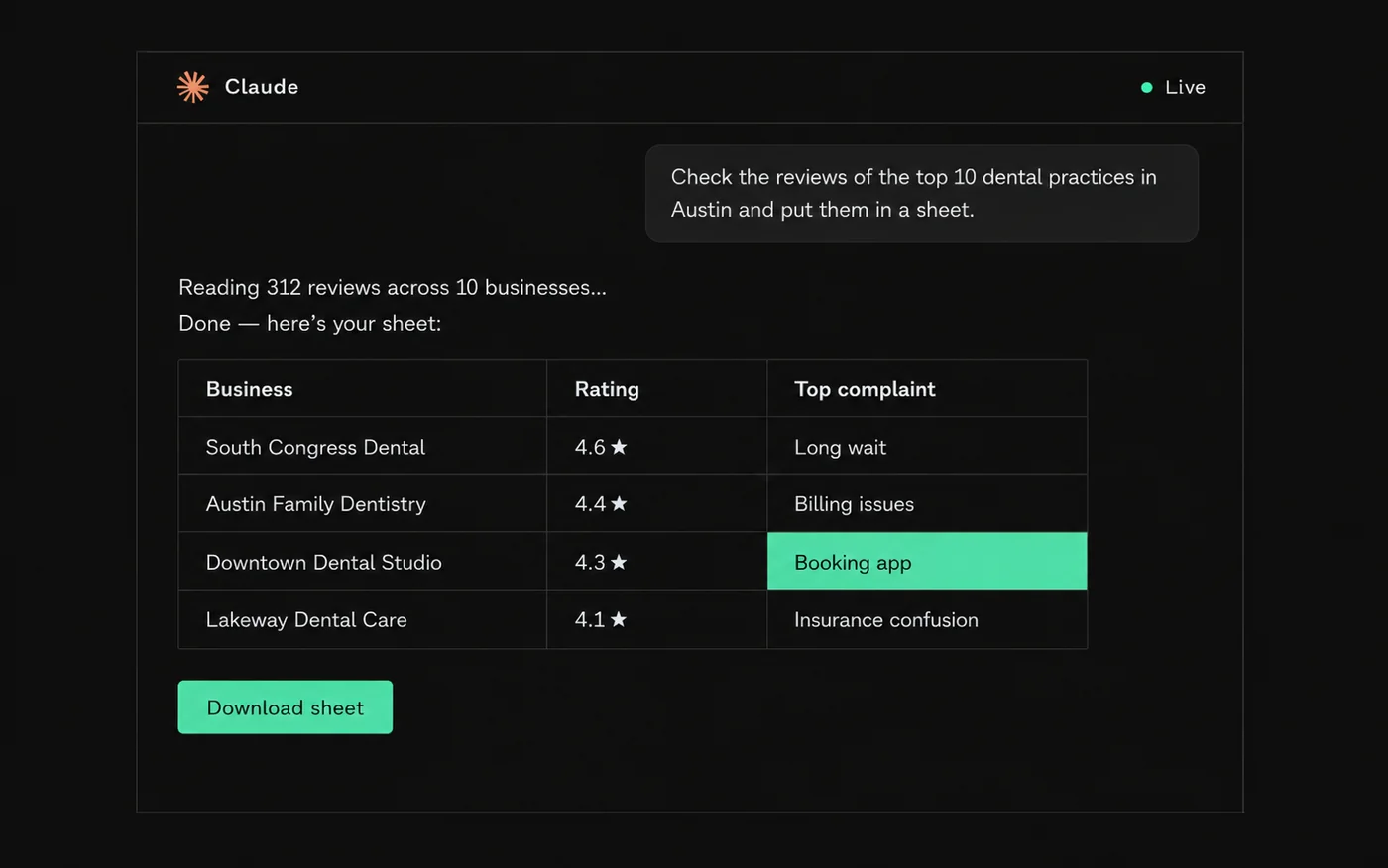
Set it up once. After that you talk to Claude in plain English, and it pulls the reviews, reads every one, and hands you a sheet you can download. No dashboards to wrangle, no code to write.
The quick questions.
What is a competitor review audit?
It is reading every public review of a business and turning it into a one page brief: what customers love, what they complain about, and where competitors are weak.
Do I need to code?
No. You ask in plain English and Claude does the work for you.
What does a run cost?
Usually a couple of dollars in tool usage. The guide shows you how to keep it lean.
Will it work for my industry?
Any business with public reviews: dentists, gyms, restaurants, agencies, software.
Can I run it on competitors?
Yes. Paste their link instead of yours. That is exactly where the gaps hide.
How do I analyze Google reviews with AI?
Collect a business's public Google reviews, then have an AI model read all of them at once. This workflow uses a scraper to pull the reviews and Claude to tag the themes, count how often each one shows up, and keep real quotes. You get a ranked brief instead of reading hundreds of reviews by hand.
Can AI read all of a business's reviews at once?
Yes, that is the point. A person gives up after a page or two, but the workflow feeds every public review to Claude in one pass, so nothing gets missed. It handles hundreds of reviews and returns the patterns a quick skim would hide.
How do I summarize customer reviews?
Group the reviews by what they are about, then rank those groups by how often they come up. The workflow has Claude do this and keep one real customer quote per theme, so the summary shows both the pattern and the exact words behind it.
How do I find out what customers say about a competitor?
Run the audit on the competitor instead of yourself. Paste their Google listing and the workflow pulls their public reviews and ranks what people praise and complain about. A complaint that repeats for them and not for you is an opening you can take.
How is this different from a star rating or a sentiment score?
A star rating and a sentiment score both flatten everything into one number. This keeps the detail: the specific complaints, how often each one appears, and the real quotes. You learn what to fix and the exact words customers used.
Run it yourself
Get the full guide.
Everything you need to run this yourself lands in your inbox. Plus a fresh workflow every week.
- The one time setup, step by step
- The exact prompt that writes the brief
- A copy and paste sheet template
- Screenshots for every step