
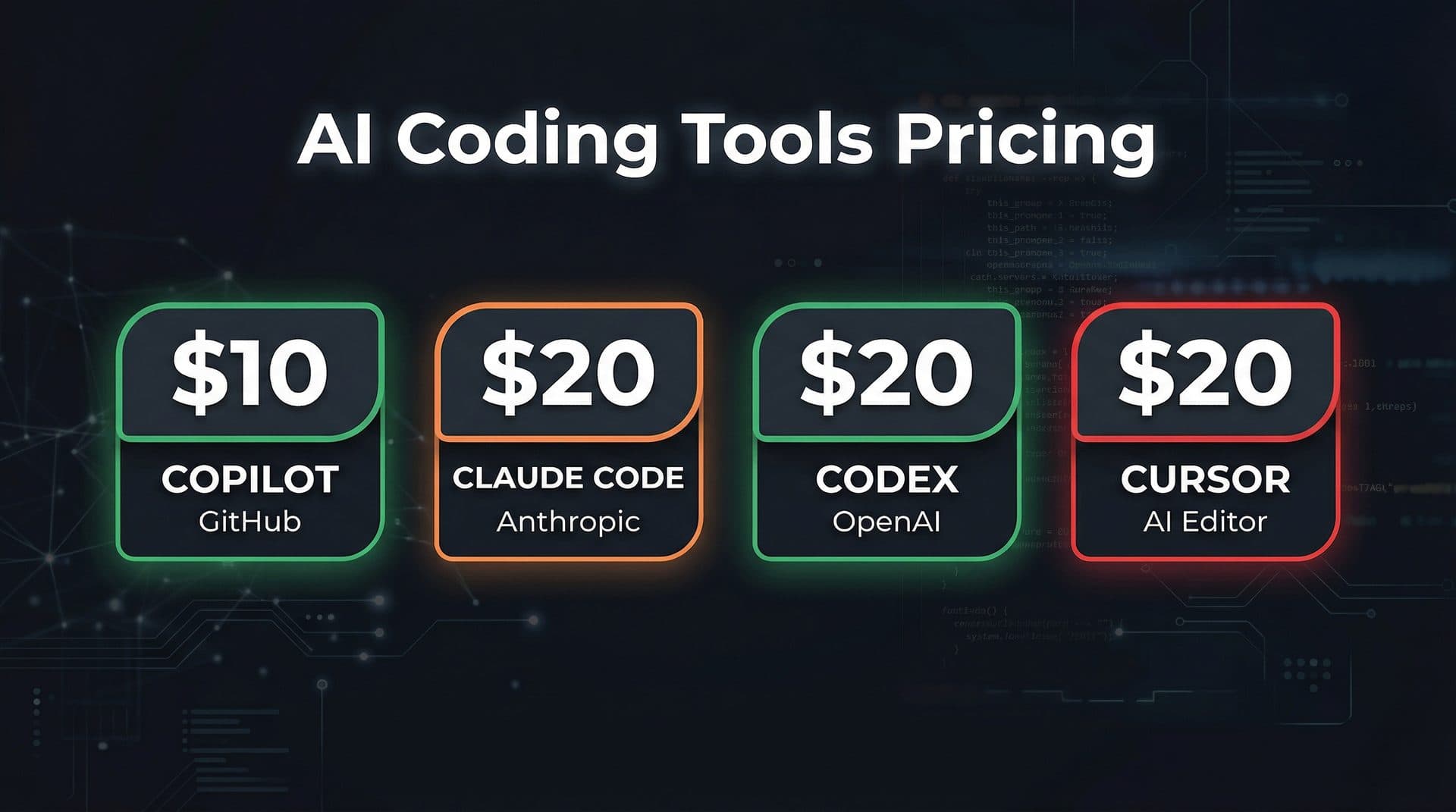
Updated October 2, 2026 (Claude Code model advice). Copilot Pro is still the cheapest paid entry at $10/month. Claude Code, Codex and Cursor start around $20, but daily agent use often pushes the realistic budget toward $60-$200. Sonnet 5 now stays at $2/$10 on the API. The August 21, 2026 Codex pricing snapshot listed GPT-5.6 Sol at $4/$20 through at least November 21. Cursor was acquired by SpaceX and now includes Origin code hosting and longer-running cloud agents, so it is no longer only an editor comparison.
- GitHub Copilot Free includes limited usage; Pro is $10/mo with $15 of monthly AI Credits; Pro+ is $39/mo with $70; Max is $100/mo with $200; Business is $19/user/mo; Enterprise is $39/user/mo.
- GitHub moved Copilot to usage-based billing on June 1, 2026: 1 AI Credit equals $0.01, and premium request allowances were retired for monthly plans.
- Claude Pro is $20/mo and includes Claude Code; Max is $100/mo for 5x Pro usage or $200/mo for 20x Pro usage.
- From v2.1.280, the built-in default Claude Code model is Opus 5.5 on direct Claude plans and the Anthropic API; Microsoft Foundry defaults to Sonnet 4.5. The August 10, 2026 Sonnet 5 pricing update described below is dated history.
- The July 9, 2026 Codex snapshot described GPT-5.6 on token-based credits, with Sol, Terra and Luna choices on Plus and higher plans and max and ultra settings.
- Cursor's official individual plans are Hobby Free, Pro $20/mo, Pro+ $60/mo, and Ultra $200/mo.
- Cursor says daily Agent users typically need $60-$100/mo total usage, while power users often need $200+/mo.
- SpaceX acquired Cursor on August 14, and Cursor now offers Origin code hosting plus event-driven cloud agents.
- Kimi Code launched with Kimi K3 on July 17, 2026: free K3 quota on Kimi accounts, paid plans from $19/mo, API at $3/$15 per million tokens.
AI coding tool pricing used to be easy to explain. Pay $10 or $20 a month, get autocomplete, maybe a chat window, done.
That is not the product anymore. The expensive part is no longer autocomplete. It is agents reading repos, running tools, doing long reasoning passes, reviewing pull requests, and spinning up cloud workspaces. That is why every pricing page now has a second layer: credits, premium requests, included usage, on-demand usage, or shared limits.
Instead of asking which one is cheapest, ask what it costs when you use the feature you rely on most.
If you care more about model quality than product pricing, compare the underlying models on our live benchmark leaderboard.
Quick Pricing Comparison
The base price is only the first number.
Official pricing snapshot - September 2026
| Tool | Entry | Heavy Use | How billing works |
|---|---|---|---|
| GitHub Copilot | Free; Pro $10/mo | Pro+ $39/mo; Max $100/mo; Business $19/user/mo; Enterprise $39/user/mo | Usage-based AI Credits since June 1, 2026 (1 credit = $0.01) |
| Claude Code | Claude Pro $20/mo | Claude Max $100/mo or $200/mo | Subscription usage limits shared across Claude and Claude Code |
| OpenAI Codex | Included with ChatGPT Free, Go, Plus, Pro, Business, and Enterprise | ChatGPT Business includes Codex at $20/user/mo billed annually ($25 monthly), plus token credits; OpenAI estimates ~$100-$200/developer/mo on average | Token-based Codex credits for most customers |
| Cursor | Hobby Free; Pro $20/mo | Pro+ $60/mo; Ultra $200/mo; Teams from $32/user/mo | Included model usage plus optional on-demand usage after limits |
| Kimi Code | Free K3 quota with a Kimi account | Paid plans from $19/mo; API $3 / $15 per 1M tokens | Free quota falls back to K2.6 when exhausted; paid plans and API lift limits |
The important correction
Do not treat any of these as simple unlimited $20 coding-agent subscriptions. The $20 tier can still be fine for light work. It is usually not the right mental model for daily agent use.
GitHub Copilot Pricing
Cheapest entry, but the billing model is changing.
GitHub's current Copilot plan docs list Free, Pro, Pro+, Max, Business, and Enterprise. The pricing table shows Pro at $10/month, Pro+ at $39/month, the new individual Max tier at $100/month, Business at $19 per granted seat per month, and Enterprise at $39 per granted seat per month. Free includes limited use.
Two things changed since the spring. First, GitHub reopened Copilot signups on June 17, 2026, reversing the pause it put on new Pro, Pro+, student, and some Business plans in April. Second, and more important for cost, the billing model switched.
As of June 1, 2026, Copilot runs on usage-based billing through GitHub AI Credits, where 1 AI Credit equals $0.01. Each plan includes a monthly credit allowance: Pro includes 1,500 credits, Pro+ includes 7,000, and the new Max tier includes 20,000. Credits are spent by token usage at each model's rate, so model choice and volume now show up directly in the bill. The old premium request allowances were retired for monthly plans, though unexpired annual Pro and Pro+ plans keep the old request-based billing until the plan expires.
My read
Copilot is still the cheapest serious entry point if you mainly want autocomplete, chat, and GitHub-native workflows. It is less clean as a cost story once you use premium models, agent mode, code review, and cloud agents heavily.
Claude Code Pricing
Easier to budget, but not unlimited.
Anthropic's pricing docs list Claude Pro at $20/month, with Claude Code included. Max is the heavy-user option: $100/month for 5x Pro capacity or $200/month for 20x Pro capacity.
The earlier advice in this guide, dated June 30, 2026, described Sonnet 5 as the default, with unchanged Pro and Max prices and limits. That is historical advice. As checked on October 2, 2026, from v2.1.280 the built-in default is Opus 5.5 on Pro, Max, Team, Enterprise and the Anthropic API, as well as Claude Platform on AWS, Amazon Bedrock and Google Cloud's Agent Platform. Microsoft Foundry defaults to Sonnet 4.5. Your model choice or organization settings can override that default.
The August 10, 2026 update recorded in this guide said Anthropic had cancelled a planned Sonnet 5 price increase from $2/$10 to $3/$15 on September 1. The current pricing page lists Sonnet 5 at $2 per million input tokens and $10 per million output tokens. That change matters for API users and metered editor plans; it does not change the $20 Pro or $100/$200 Max subscriptions.
Claude Code itself is broader than a terminal wrapper now. Anthropic's docs describe it as an agentic coding tool that reads your codebase, edits files, runs commands, creates commits, and works across terminal, IDE, desktop, and browser surfaces. That matters because the same subscription can cover more than one coding workflow.
The catch is limits. Anthropic says Pro usage resets every five hours and varies by prompt length, attached files, conversation size, model, and feature. Max gives more usage, not infinite usage. Anthropic also says usage can be limited through weekly/monthly caps or model and feature limits.
If you want a fixed monthly ceiling, Claude Code is easier to reason about than token-based credits. If you want unlimited uninterrupted coding-agent use, it is not that.
OpenAI Codex Pricing
Included with ChatGPT plans, priced through credits for serious usage.
OpenAI's help center says Codex is included with ChatGPT Free, Go, Plus, Pro, Business, and Enterprise/Edu.
The pricing detail that matters is the April 2026 change. OpenAI's Codex rate card says Codex pricing moved from per-message pricing to token-based credits on April 2, 2026 for new and existing Plus, Pro, and ChatGPT Business customers, plus new ChatGPT Enterprise plans. On April 23, 2026, OpenAI applied the update to existing Enterprise, Edu, Health, Gov, and ChatGPT for Teachers plans as well.
Under the new rate card, Codex credit usage depends on input tokens, cached input tokens, output tokens, model choice, fast mode, and code review usage. OpenAI's own planning note says Codex averages about $100-$200 per developer per month, with large variance depending on model, concurrent instances, automations, and fast mode.
For teams, ChatGPT Business includes Codex and is priced per seat at $20 per user per month billed annually, or $25 per user per month billed monthly, with additional token-based credit usage available beyond the included limits.
In the July 9, 2026 lineup described in this guide, the GPT-5.6 family reached general availability in Codex. Free and Go users got GPT-5.6 Terra, while Plus and higher plans could choose among Sol, Terra, and Luna and set an effort level for each. Two new settings matter for cost. The max setting, which anyone with GPT-5.6 access can toggle on, gives the model extra time to reason. The ultra setting, available in Codex on Plus and higher plans, runs four agents in parallel by default and trades higher token use for stronger results. Both show up directly in credit usage, so treat them as accelerators you switch on for hard problems rather than defaults.
OpenAI cut Sol's token rate on August 21. The August 21, 2026 pricing snapshot in this guide listed a promotional price of $4 input, $0.40 cached input and $20 output per million tokens through at least November 21, down from $5/$0.50/$30. Codex credits now reach further on Sol, but max and ultra can still burn through them quickly because they deliberately spend more tokens.
Want the full low-cost build setup? See the exact stack behind a live product.
Codex budget rule
Codex can be cheap for light local tasks and expensive for broad repo exploration. The new token-based rate card makes that visible instead of hiding it behind a single message count.
Cursor Pricing
Best AI editor experience, but agent use is the cost driver.
Cursor's official pricing page lists Hobby Free, Pro at $20/month, Pro+ at $60/month, Ultra at $200/month, and Enterprise as custom. Teams pricing changed in June 2026 to a two-tier structure: Standard at $32/seat/month billed annually ($40 monthly) and a new Premium tier at $96/seat/month billed annually ($120 monthly).
Cursor's usage docs explain what those tiers mean. Pro includes about $20 of agent usage, Pro+ includes about $70, and Ultra includes about $400. Cursor says different models have different API costs, so model choice affects output tokens and how fast included usage is consumed.
The same docs give a useful planning range: daily Tab users usually stay within $20, limited Agent users often stay within included Pro usage, daily Agent users typically land around $60-$100/month, and power users using multiple agents or automation are often $200+/month.
That makes Cursor easier to price than the old rumor mill suggested, but it also means Pro is not the right benchmark for heavy Agent users. If you use Cursor as an editor with Tab and occasional Agent work, Pro may be enough. If Cursor Agent is doing a large part of your coding day, Pro+ or Ultra is the realistic comparison. Cursor's own pricing FAQ now says this outright: it recommends Pro+ for daily agent users and Ultra for agent power users.
SpaceX completed its acquisition of Cursor on August 14. The product also moved beyond the local editor: Origin can host repositories and pull requests, and cloud agents can watch PRs or Slack threads, respond to events, fix CI failures and continue long-running work. The subscription still pays for model usage, so those agents can consume the included pool while you are away from the editor.
Kimi Code Pricing
The new budget entrant, with a frontier model behind it.
Kimi Code is the newest tool on this list and the reason this comparison stopped being a four-way race. Moonshot launched Kimi K3 on July 17, 2026, and Kimi Code is its terminal agent: install it, run it in your repo, and select K3 with the /model command. It covers the same ground as Claude Code and Codex, reading the codebase, editing files, and running commands.
The pricing is the draw. A free Kimi account includes a K3 usage quota, paid plans start at $19/month, and the API costs $3 per million input tokens and $15 per million output, with cached input at $0.30. That undercuts every paid tier here except Copilot Pro, and unlike Copilot Pro it puts a frontier flagship behind the agent: on Moonshot's published numbers, K3 scores 88.3% on Terminal-Bench 2.1, half a point behind GPT-5.6 Sol and ahead of everything from Anthropic.
There are two catches we found by using it. First, speed: independent testing measures K3 at about 35 output tokens per second, the slowest of the major flagships, which you feel in interactive sessions even if long agent runs hide it. Second, the free quota has a hidden behavior: when your free K3 allowance runs out, kimi.com quietly serves K2.6 instead, without telling you. We documented that firsthand in our Kimi K3 review. On the paid plans and API, you get the model you selected.
Where Kimi Code fits
Treat it as the budget seat for long agent runs, or as a second agent next to Claude Code or Codex. At $19/month it is the cheapest way to put a frontier-class model on repo work. Just verify which model actually answered before you trust free-tier output.
What Real Developers Report
Anecdotes are not benchmarks, but they show where billing feels confusing.
I checked real-user threads after the official docs because the docs tell you the rules, not always how they feel in a normal week.
The Cursor Forum pattern is clear: users are trying to decide whether Pro+ is worth it when Pro plus usage-based charges already costs another $40-$80/month. Other threads come from very heavy users spending far beyond Ultra's included usage and asking whether Ultra changes anything for a $1,000-$2,000/month workflow. That is an edge case, but it explains why the "$20 Cursor" framing is weak.
Copilot's subreddit has a different pain point: premium request accounting. Users ask what counts as a premium request, whether small follow-ups consume quota, why a single prompt can consume many requests through certain integrations, and why Pro+ sometimes appears exhausted right after signup. Some of that may be bugs, some may be integrations, and some is just the cost of using expensive models through an allowance system.
Codex user threads after the April 2026 rate-card change focus on token waste. Developers are watching agents spend credits on repo orientation before writing code. That matches the official token-based model: broad context gathering now shows up in the bill.
The human pattern
Developers react to unclear counters as much as they react to price. If a tool says "$20" but the useful features feel metered, users want the meter to be obvious before they run the agent.
What You Should Budget
Use workflow, not marketing tier, as the budget line.
Practical monthly budget by workflow
| Workflow | Likely budget | Best fit |
|---|---|---|
| Autocomplete and light chat | $0-$20 | Copilot Free/Pro, Cursor Hobby/Pro |
| Daily editor use with occasional agents | $20-$60 | Cursor Pro/Pro+, Copilot Pro/Pro+ |
| Terminal agent for repo work | $19-$200 | Claude Pro/Max, Codex through ChatGPT plans, Kimi Code from $19/mo |
| Daily multi-agent coding | $100-$200+ | Claude Max, Cursor Ultra, Codex credits |
| Team rollout with controls | $19-$120/user/mo plus usage where applicable | Copilot Business/Enterprise, Cursor Teams, ChatGPT Business/Codex, Claude Team/Enterprise |
Run your own usage through our AI cost calculator if you already know your rough token volume, agent count, or daily task count.
Which One Fits Your Budget?
Pick the workflow first. Then pick the plan.
The decision
- 1Mostly autocomplete and IDE chat? Start with Copilot or Cursor.
- 2VS Code-style editor with strong Tab and visual diffs? Cursor is the natural fit.
- 3Terminal-first coding agent with git, commands, and automation? Claude Code is the cleaner fit.
- 4OpenAI-heavy workflow or cloud coding agent inside ChatGPT/Codex? Use Codex, but watch credits.
- 5Lowest paid entry price? Copilot Pro is $10/mo, now on usage-based AI Credits since June 1.
- 6Cheapest frontier-model agent? Kimi Code's free K3 quota, then $19/mo, undercuts every $20 tier here.
- 7Daily agent user? Budget $60-$200 instead of pretending the answer is always $20.
My default recommendation is boring but practical: use one editor assistant and one agent only if both earn their keep. Cursor or Copilot can handle the constant small edits. Claude Code or Codex can handle the heavier repo tasks. If you are not opening one of them every day, cancel it. The coding tool is only one line on the bill anyway; when I totaled up every tool I use and what it costs to run my own company, a single $20 subscription covered the coding and nearly everything else stayed on a free tier.
The wrong move is choosing from the sticker price alone. The cheapest tool is the one whose limits match your workflow.
If you are still choosing which model to run inside these tools, our AI model picker narrows it down with six quick questions about your tasks and budget.
Sources Checked
Official sources for facts, user threads for lived experience.
Official sources used for factual claims:
- GitHub Docs: Plans for GitHub Copilot
- GitHub Copilot plans and pricing
- GitHub Docs: usage-based billing for individuals
- GitHub Docs: Copilot models and pricing
- Claude pricing
- Claude Help Center: choosing a Claude plan
- Anthropic Help Center: Claude Pro usage
- Anthropic Help Center: Claude Max usage
- Claude Code model configuration (checked October 2, 2026)
- Claude Code overview
- OpenAI Help Center: using Codex with your ChatGPT plan
- OpenAI Help Center: Codex rate card
- ChatGPT pricing
- Cursor pricing
- Cursor Models & Pricing docs
- Cursor: joining SpaceX
- Cursor changelog: Origin and cloud agents
- OpenAI: GPT-5.6 launch post (Codex availability and pricing)
- Anthropic: Sonnet 5 pricing update
- Moonshot AI: Kimi K3 tech blog (Kimi Code availability and API pricing)
Real-user feedback checked:
- Cursor Forum: Is Pro+ worth it?
- Cursor Forum: Ultra vs heavy usage-based spending
- Cursor Forum: docs and dashboard cost visibility
- Reddit: what constitutes a Copilot premium request?
- Reddit: high Copilot premium request usage from one prompt
- Reddit: Copilot Pro+ premium requests showing exhausted after signup
- Reddit: Codex token-credit usage after the April 2026 rate-card change
- Reddit: Claude Code vs Cursor user reports
- Hacker News: Claude Code vs Cursor discussion
FAQ
What is the cheapest paid AI coding tool?
GitHub Copilot Pro is the cheapest paid option here at $10/month. Kimi Code's paid plans start at $19/month and put Moonshot's K3 flagship behind the agent. The rest of the practical entry tier is $20/month: Claude Pro with Claude Code, Cursor Pro, or ChatGPT Plus with Codex access.
Which tool has the most predictable pricing?
Claude Code is easiest to budget because Pro, Max 5x, and Max 20x are subscription tiers. That does not mean unlimited. Anthropic still applies usage limits. Cursor, Codex, and Copilot increasingly expose usage through credits and model costs, and Copilot itself moved to usage-based AI Credits on June 1, 2026.
How much should a daily coding-agent user budget?
Budget $60-$200/month if agents are doing real work every day. Cursor's own docs put daily Agent users around $60-$100/month and power users at $200+/month. OpenAI says Codex averages about $100-$200/developer/month, with large variance. Claude Max and Cursor Ultra sit in that same range.
Is Cursor more expensive than Claude Code?
For light use, not necessarily. Cursor Pro is $20/month and may be enough if you mostly use Tab and occasional Agent requests. For daily Agent use, Cursor's own docs point to $60-$100/month. Claude Pro is cheaper if your usage fits the limits; Claude Max is the better comparison for heavy use.
Should I use one AI coding tool or two?
Use two only if they do different jobs. A reasonable split is Cursor or Copilot for daily editor assistance, plus Claude Code or Codex for heavier agent work. If both tools solve the same problem for you, keep the one you use more.
Is Kimi Code a real alternative to Claude Code or Codex?
For budget-focused agent work, yes. Kimi Code runs Moonshot's K3 flagship, which scores 88.3% on Terminal-Bench 2.1, with a free quota and paid plans from $19/month. The trade-offs are speed, about 35 output tokens per second, and a free tier that silently falls back to K2.6 once the K3 quota is exhausted. Paid plans and the $3/$15 API serve the model you selected.

Founder of Spectrum AI Labs — testing AI tools and models, and writing up what actually ships.
More about Paras →Stay ahead of the AI curve
We test new AI tools every week and share honest results. Join our newsletter.

![Free AI Coding Tools Compared: What You Get for $0 [2026]](/_next/image?url=%2Fimages%2Ffree-ai-coding-tools-compared-2026.svg&w=3840&q=75)