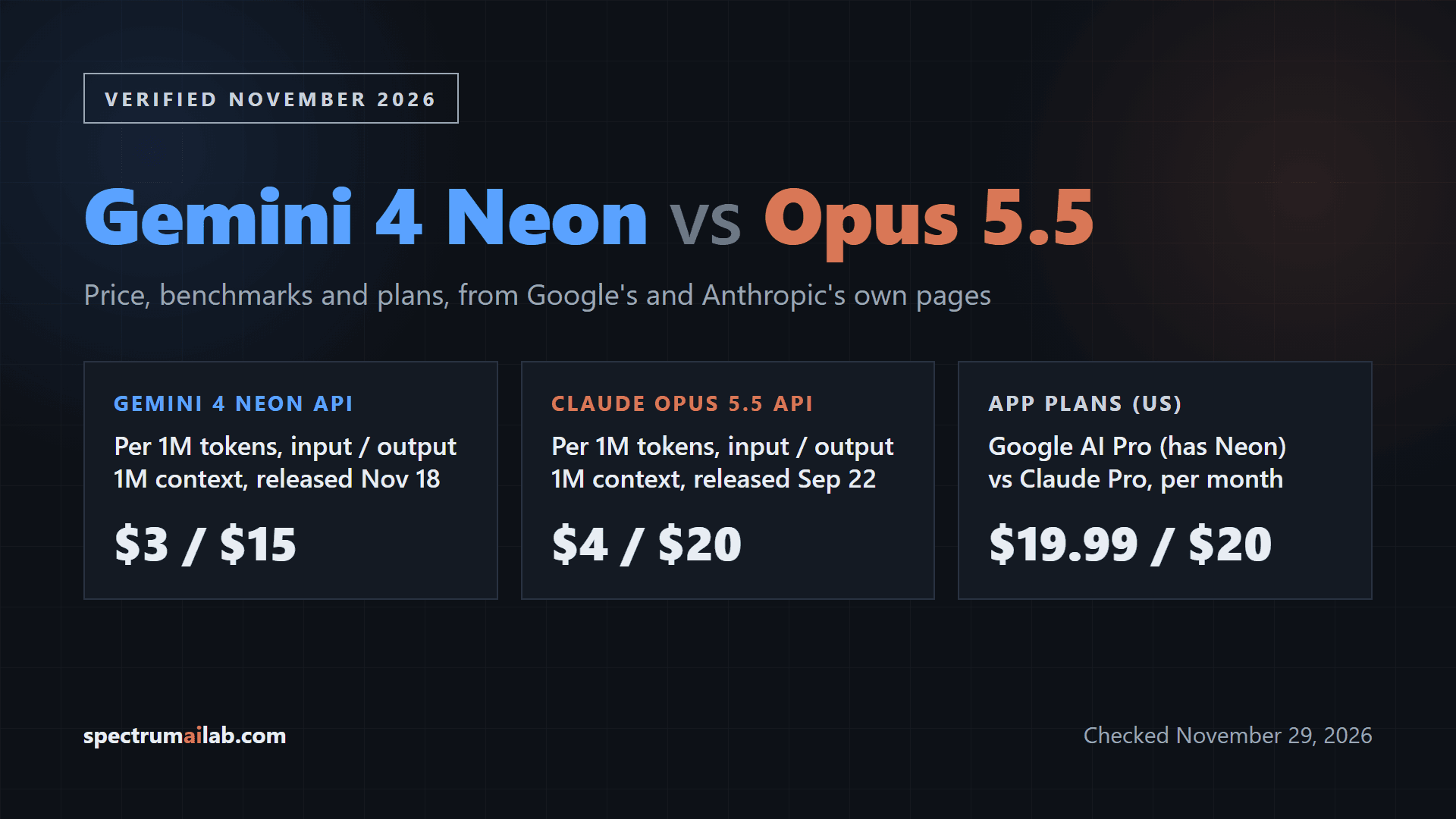
Neon is cheaper per token. Neither model is better overall. Gemini 4 Neon costs $3 input and $15 output per 1M tokens. Claude Opus 5.5 costs $4 and $20. That makes Neon 25% cheaper per token (our math). On Google's own benchmark table, Opus 5.5 leads on two rows by small margins, and Neon leads on every other row where Opus 5.5 has a score. Those are Google's numbers, not independent ones. Price per token also does not tell you price per task, so test your own work on both. For plans, Google AI Pro ($19.99) is the cheapest paid way to get Neon in the Gemini app, and Claude Pro ($20) includes Opus 5.5. I checked Google's and Anthropic's pages between November 27 and 29, 2026.
Quick comparison
Both models, one table.
A token is a small piece of text, often part of a word. AI companies charge by the token, so prices are quoted per 1M tokens. The context window is how much text a model can read at once. The knowledge cutoff is the date after which the model knows nothing new.
Gemini 4 Neon vs Claude Opus 5.5
| Gemini 4 Neon | Claude Opus 5.5 | |
|---|---|---|
| Made by | Anthropic | |
| Released | Nov 18, 2026 | Sep 22, 2026 |
| Input price | $3 per 1M | $4 per 1M |
| Output price | $15 per 1M | $20 per 1M |
| Batch price | $1.50 / $7.50 | $2 / $10 |
| Context window | 1M tokens | 1M tokens |
| Max output | 64K default, up to 1M | 128K |
| Knowledge cutoff | March 2026 | June 2026 |
| Cheapest plan with it | Google AI Pro, $19.99 | Claude Pro, $20 |
Source: Google AI Studio pricing and model pages, Google blog and model card, Anthropic Opus 5.5 pages. Output price on Neon includes thinking tokens. Checked November 29, 2026
- Released by Google on November 18, 2026, adapted from Gemini 4 Carbon
- Model id gemini-4-neon, 1M token context window, March 2026 knowledge cutoff
- Standard API price is $3 input and $15 output per 1M tokens, with no free API tier
- Available in the Gemini API paid tier, Google AI Studio, Gemini for business, Antigravity and the Gemini app for AI Pro and Ultra
- On Google's own benchmark table, Claude Opus 5.5 leads on 2 of the 18 rows where it has a score
Price per token and a worked example
Neon is 25% cheaper on paper.
Neon costs $3 per 1M input tokens and $15 per 1M output tokens. Opus 5.5 costs $4 and $20. That is 25% less on both input and output (our math). Cached input, which means text the model has already seen in the same job, is $0.15 on Neon and $0.20 for an Opus 5.5 cache read, also 25% less (our math). Neon supports implicit caching only, and explicit caching is not supported.
Here is a worked example (our math). Say a job sends 1M tokens in and gets 200K tokens back. On Neon, that is $3 for input plus $3 for output, so $6. On Opus 5.5, it is $4 plus $4, so $8. Neon is $2 cheaper on that job.
API prices per 1M tokens
| Neon | Opus 5.5 | |
|---|---|---|
| Standard in | $3 | $4 |
| Standard out | $15 | $20 |
| Cached in | $0.15 | $0.20 |
| Batch in | $1.50 | $2 |
| Batch out | $7.50 | $10 |
Source: Google AI Studio pricing page and Anthropic pricing docs, checked November 29, 2026. Batch is work you send in bulk and wait longer for. Google lists Batch and Flex for Neon at the same price
Both companies also sell a premium tier, but they are different products. Google's Priority tier for Neon costs $5.40 input and $27 output, and Anthropic's Fast mode for Opus 5.5 costs $8 and $40. I do not line them up as equals.
Google also lists a Grounding with Google Search option. It includes 5,000 free search requests per month, shared across all Gemini 3 and newer models, then $14 per 1,000 requests, with a daily cap.
Per token is not per task
A lower token price does not guarantee a lower bill. A model that thinks longer, or needs more turns to finish a job, can cost more per task even at a cheaper token price. Neon's output price includes its thinking tokens, which are the words the model writes to itself while it works out an answer. Thinking levels are a setting that tells the model how long to think. Neon has four, with high as the default and xhigh at the top. Google also says Neon costs roughly 50 to 80% less per task than top competing models. Google does not say which models it means, so I do not apply that to Opus 5.5. Each company also counts tokens its own way, so the same text can be a different number of tokens on each model.
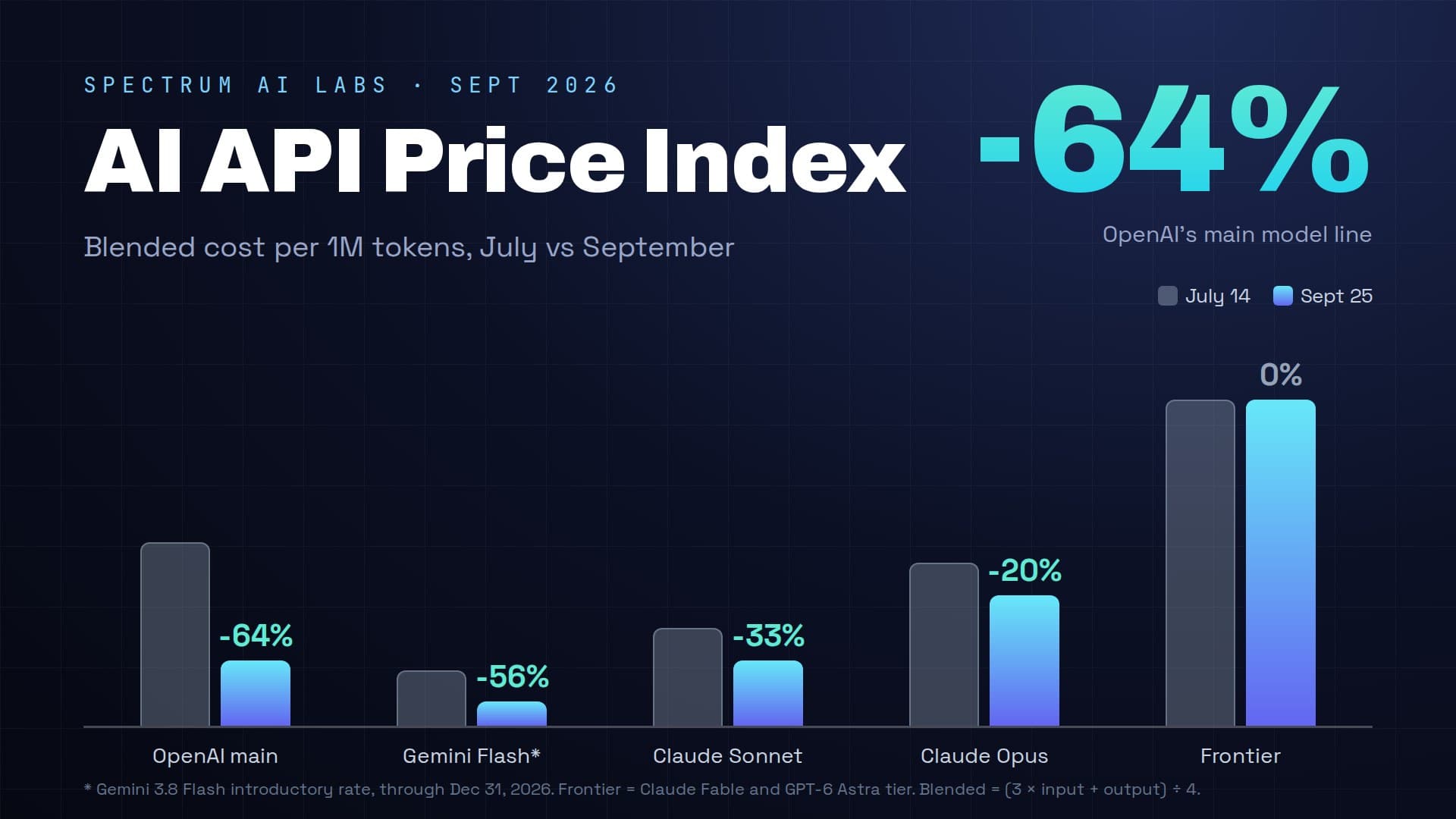
For a wider view, my AI API price index lists the cost per 1M tokens of every major model in one place.
Benchmarks: Google's own table
Useful, but not independent.
Every number in this section comes from Google, not from an outside lab. A benchmark is a standard test that gives a model a score. Companies choose which tests to show and how to run them, so treat a vendor's table as a starting point. Google posted its Neon table on X on November 21, three days after release, and it is also on the model card. It compares Neon with Claude Opus 5.5 and GPT-6.2 Sol.
The official News from Google account posted the table below. The post also makes Google's claim of roughly 50 to 80% lower cost per task than top competing models, without naming them.
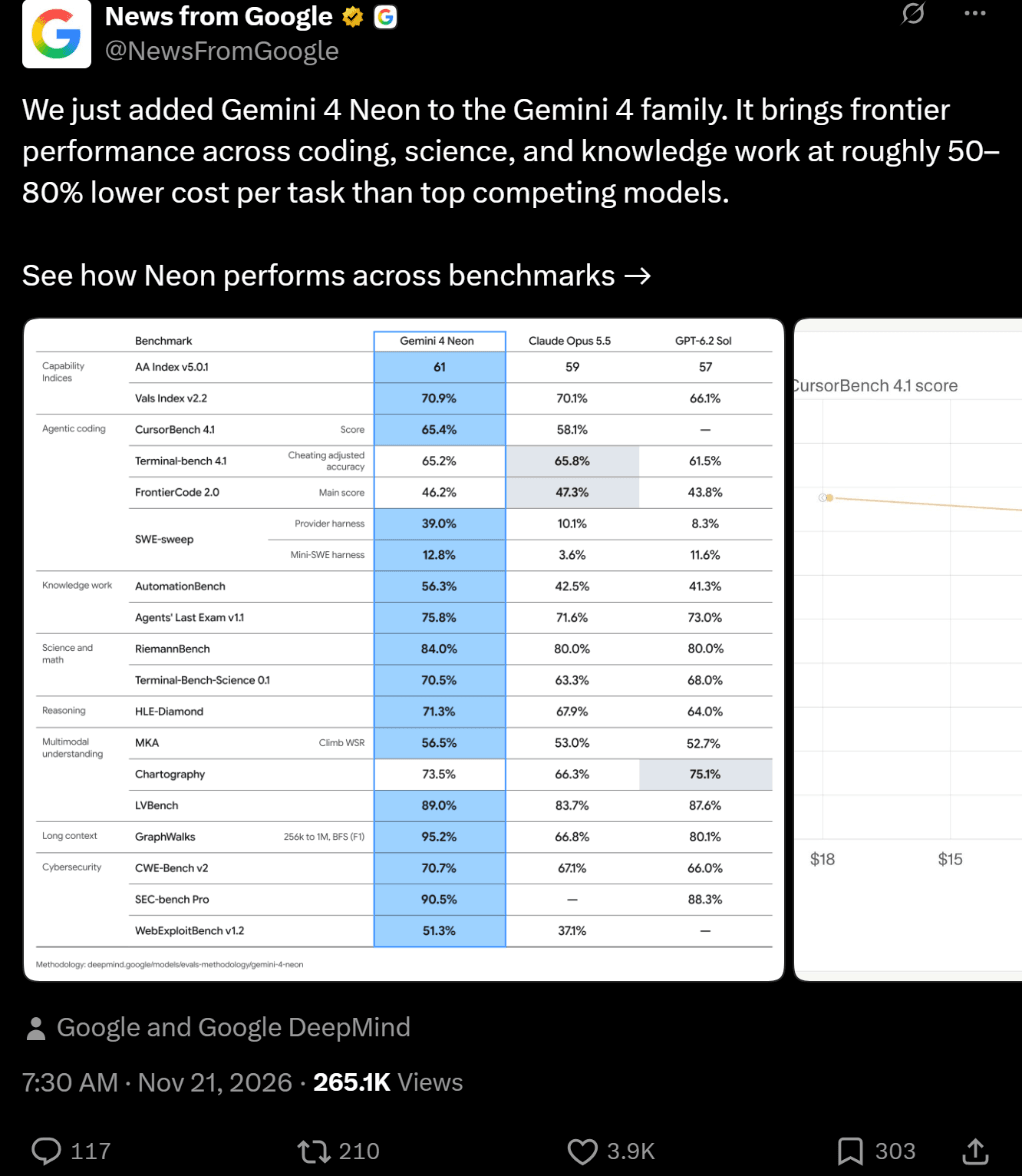
Where Opus 5.5 leads. On Google's table, Opus 5.5 is ahead on exactly two rows, and both gaps are small.
Rows where Opus 5.5 leads (Google's table)
| Neon | Opus 5.5 | Gap | |
|---|---|---|---|
| Terminal-bench 4.1 | 65.2% | 65.8% | 0.6 points |
| FrontierCode 2.0 | 46.2% | 47.3% | 1.1 points |
Source: Google's Gemini 4 Neon model card and the November 21, 2026 post. Terminal-bench 4.1 is the cheating adjusted score. Gaps are our math
Where Neon leads. On every other row where Opus 5.5 has a score, Neon is ahead. That includes coding rows, so this table does not support saying Opus 5.5 wins on coding. Here are the four biggest gaps plus two more rows, using Google's names for each test.
Where Neon leads (Google's table, selected rows)
| Neon | Opus 5.5 | Gap | |
|---|---|---|---|
| SWE-sweep (provider) | 39.0% | 10.1% | 28.9 points |
| GraphWalks | 95.2% | 66.8% | 28.4 points |
| WebExploitBench | 51.3% | 37.1% | 14.2 points |
| AutomationBench | 56.3% | 42.5% | 13.8 points |
| CursorBench 4.1 | 65.4% | 58.1% | 7.3 points |
| AA Index v5.0.1 | 61 | 59 | 2 points |
Source: Google's Gemini 4 Neon model card and the November 21, 2026 post. SWE-sweep (provider) is Google's SWE-sweep with the provider harness. GraphWalks is the 256K to 1M version. Gaps are our math
The same table has a second SWE-sweep row, run with a different setup (the Mini-SWE harness). It reads 12.8% for Neon and 3.6% for Opus 5.5. GPT-6.2 Sol beats Neon on only one row, Chartography, 75.1% to 73.5%. Neon's score on the Vals Index v2.2 is 70.9% against 70.1% for Opus 5.5, a gap of 0.8 points (our math).
Google's model card also says that for its biological and cybersecurity critical capability levels, reaching them "cannot be ruled out", and that Google continues to deploy mitigations. That is a safety note, not a score.
What people on X found
Single runs and opinions, not proof.
Benchmarks are tidy. Real use is not. These posts are single runs and personal opinions by individual people, so use them as background, not as evidence.
One question that reached 354K views came from Shokhrukh Karimov (@shokhkarim1212) on November 24: "convince me to switch to Gemini 4 Neon. i'm a claude user. is Neon that good or just hype?" Dakota (@byteotter) answered it.
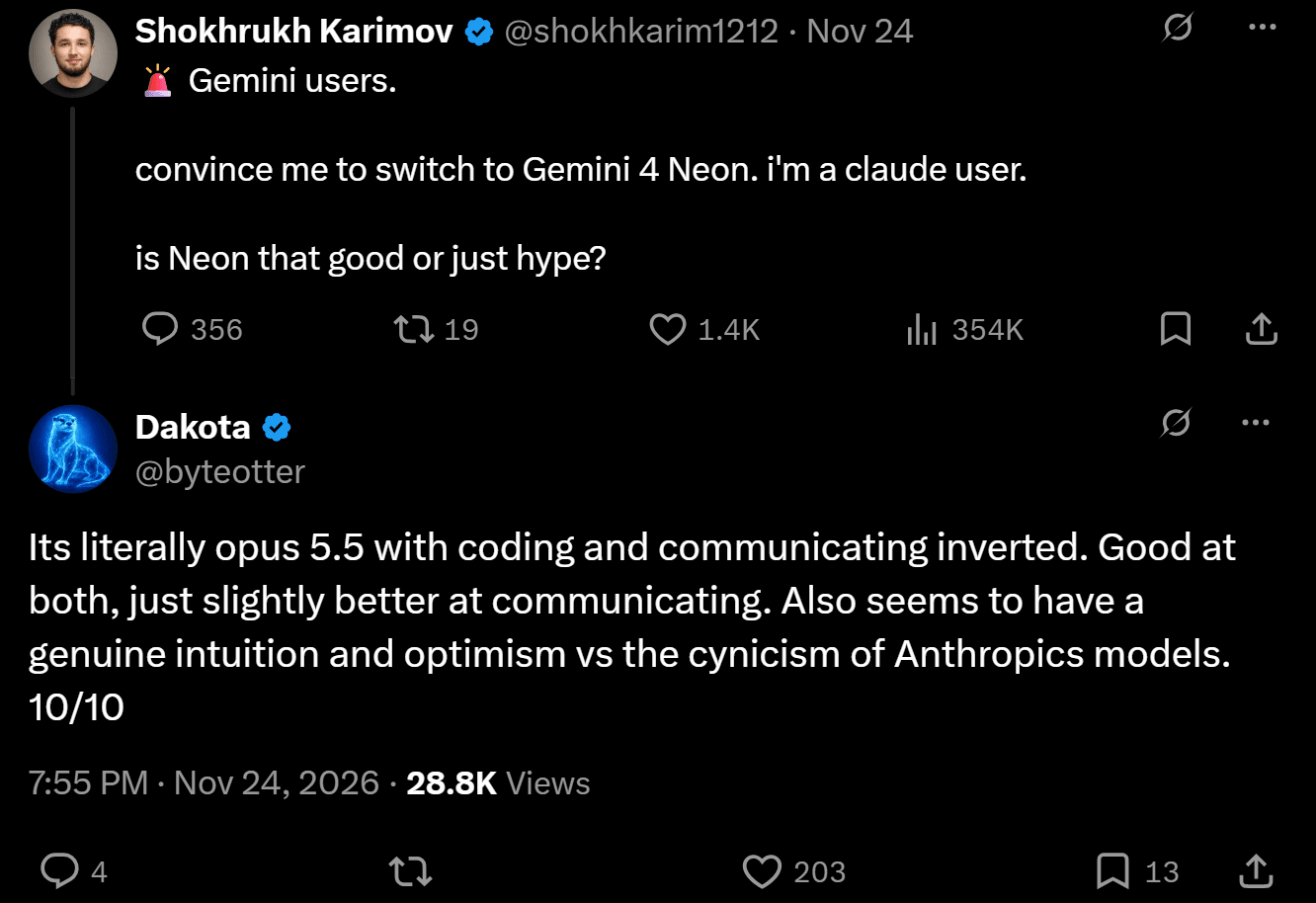
Dakota's reply opens: "Its literally opus 5.5 with coding and communicating inverted. Good at both, just slightly better at communicating." It goes on to say Neon "seems to have a genuine intuition and optimism vs the cynicism of Anthropics models" and ends "10/10". That is one person's impression, and Dakota does not share a test with it.
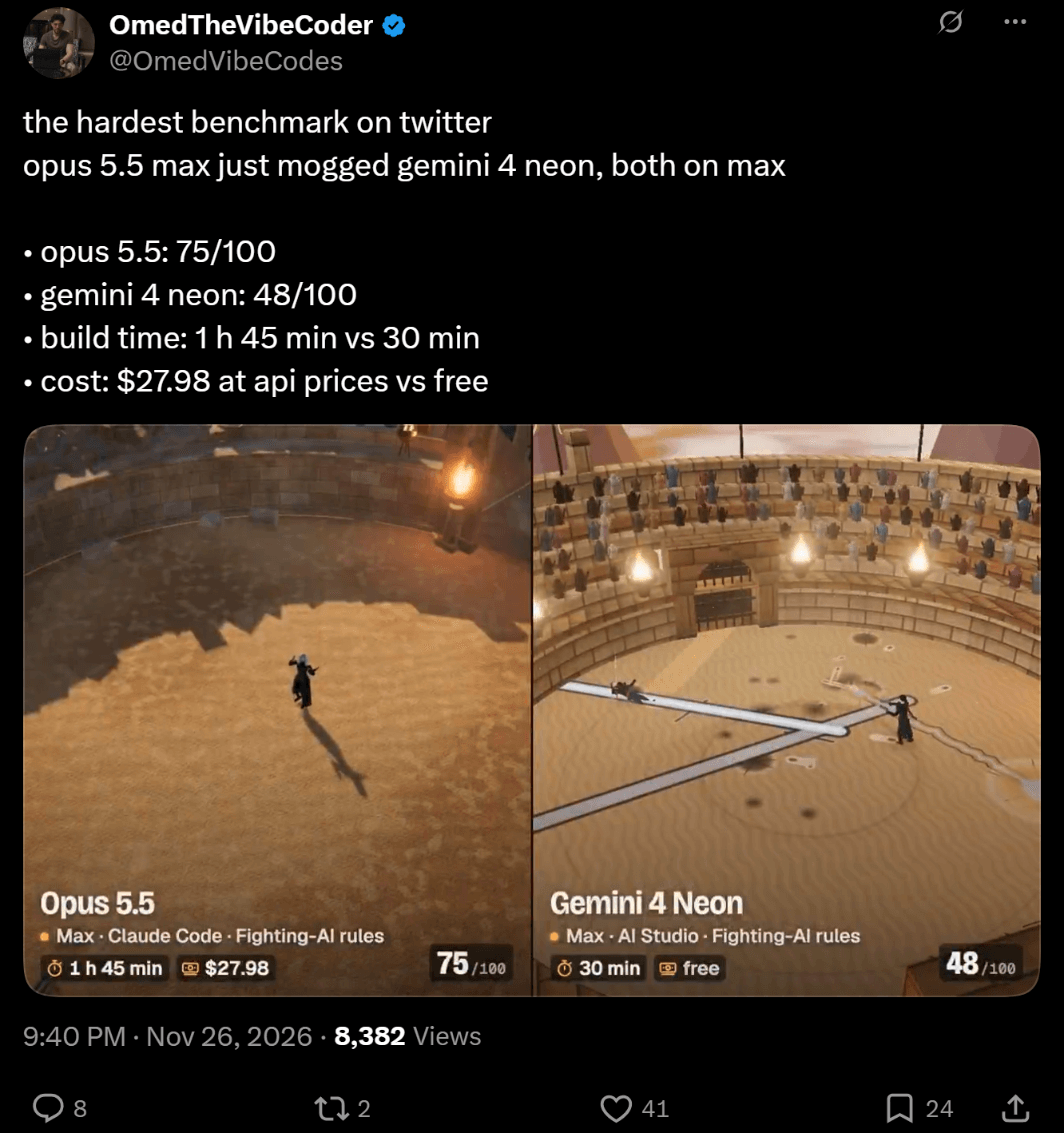
For a test with numbers, here is OmedTheVibeCoder (@OmedVibeCodes), who tried a game-building task on November 26. The post is labelled "both on max". In that single run, Opus 5.5 in Claude Code scored 75/100 in 1 hour 45 minutes and cost $27.98 at API prices. Gemini 4 Neon in AI Studio scored 48/100 in 30 minutes, and the post lists it as "free". The scores are the poster's own. Note that Google's pricing page lists no free API tier for Neon, so I only report what the post says. This is the counterpoint to the benchmark table: Opus 5.5 scored higher in this run, and Neon finished in less than a third of the time (our math).
Choosing between AI models for real work? Get a practical setup that wastes less of your limit.
Gemini 4 Neon vs Carbon vs Hydrogen
Three models, three jobs.
Neon is one of three Gemini 4 models on Google's plans page. A fourth, Gemini 4 Argon, is in the API at the same price as Carbon. I leave it out because Google's plans page lists only these three. Google positions the three like this. Carbon is for the hardest long-horizon work. Neon is for complex, high-frequency workflows that need to be faster and cheaper. Hydrogen is for fast everyday tasks. Neon was adapted from Carbon, according to its model card. Google also says Neon costs about 32% less per task than Carbon at default (high) thinking on the Artificial Analysis Index.
Gemini 4 models and prices
| Carbon | Neon | Hydrogen | |
|---|---|---|---|
| Best for | Hardest long tasks | Complex, frequent work | Fast everyday tasks |
| Price per 1M | $4 / $20 from Dec 1 | $3 / $15 | $1.50 / $7.50 |
| Free API tier | No | No | Yes |
| In Google AI Plus | Not listed | Not listed | Yes |
| In Google AI Pro | Not listed | Yes | Yes |
| In Google AI Ultra | Yes | Yes | Yes |
Source: Google AI Studio pricing page, Google's Neon announcement and the US plans page, checked November 29, 2026. Carbon's intro price of $2 / $10 ends November 30
One date matters here. Carbon's intro price of $2/$10 ends November 30. From December 1 it is $4/$20, which makes Neon the cheaper of the two. Hydrogen at $1.50/$7.50 is half of Neon's price on both sides (our math).
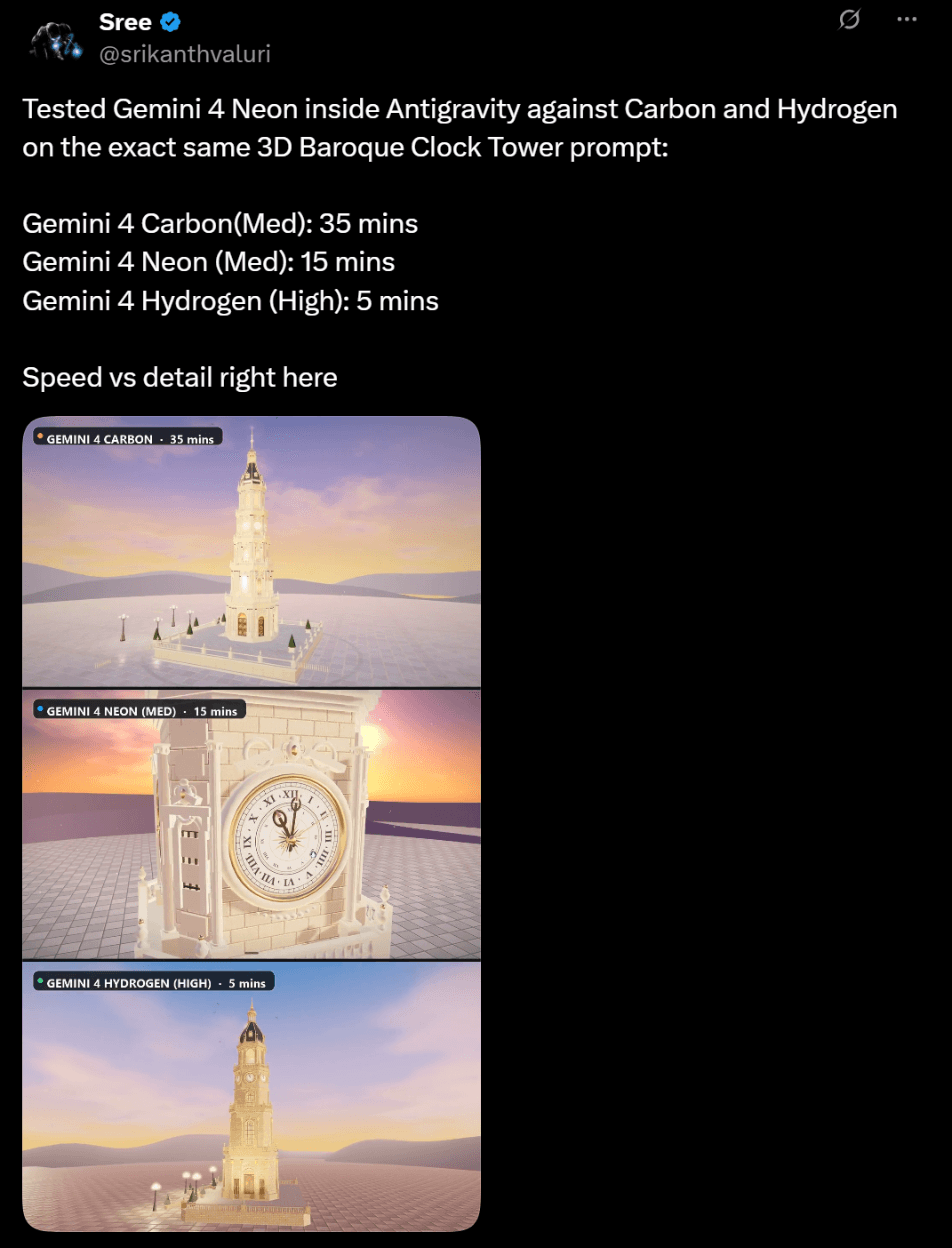
Speed is part of the trade. Sree (@srikanthvaluri) ran the same 3D clock tower prompt in Antigravity, Google's agentic coding platform, on November 28. Carbon (medium thinking) took 35 minutes, Neon (medium) took 15 minutes, and Hydrogen (high) took 5 minutes. Sree's own summary is "Speed vs detail". It is one prompt, one run, and the thinking levels differ between models.
For how the older Flash line and the Gemini 4 family fit together, see my Gemini 3.8 Flash guide, which has a Gemini 4 family table.
Plans: Google AI vs Claude
Where you can use each model without the API.
Neon is not on Google's Free or Plus plans in the Gemini app. It starts at Google AI Pro. Opus 5.5 is in Claude Pro, Max, Ultra, Team and Enterprise, and not in Free. All prices below are US monthly prices.
Google AI plans and Neon access
| Price | Neon in app? | |
|---|---|---|
| Free | $0 | No |
| AI Plus | $4.99 | No (Hydrogen) |
| AI Pro | $19.99 | Yes |
| AI Ultra 5x | $99.99 | Yes, highest |
| AI Ultra 20x | $199.99 | Yes, highest |
Source: gemini.google/us/subscriptions, read November 29, 2026. Ultra 5x and 20x mean 5x and 20x the usage limits of AI Pro. Only the Ultra plan lists Carbon in the Gemini app. Prices differ outside the US
Google says Plus has 2x the usage of Free and Pro has 4x. Its limits depend on how complex your prompts are, which features you use and how long your chats run. Google also says the limit refreshes every 5 hours until you reach a weekly limit, and you can buy AI credits to extend it. In the Gemini app, the context size is 32K with no plan, 128K on Plus, and 1M on Pro and Ultra. For Antigravity, the Pro plan lists entry rate limits for the agent model, and Ultra lists higher ones.
Some prices line up almost exactly. This is our framing, and it is only about price, not about what you get.
Same-price pairs
| Claude | ||
|---|---|---|
| About $20 | AI Pro, $19.99 | Pro, $20 |
| About $100 | AI Ultra 5x, $99.99 | Max, $100 |
| About $200 | AI Ultra 20x, $199.99 | Ultra, $200 |
Source: Google's US plans page and claude.com/pricing, checked November 29, 2026. Pairs are our framing. Usage units are not comparable across companies
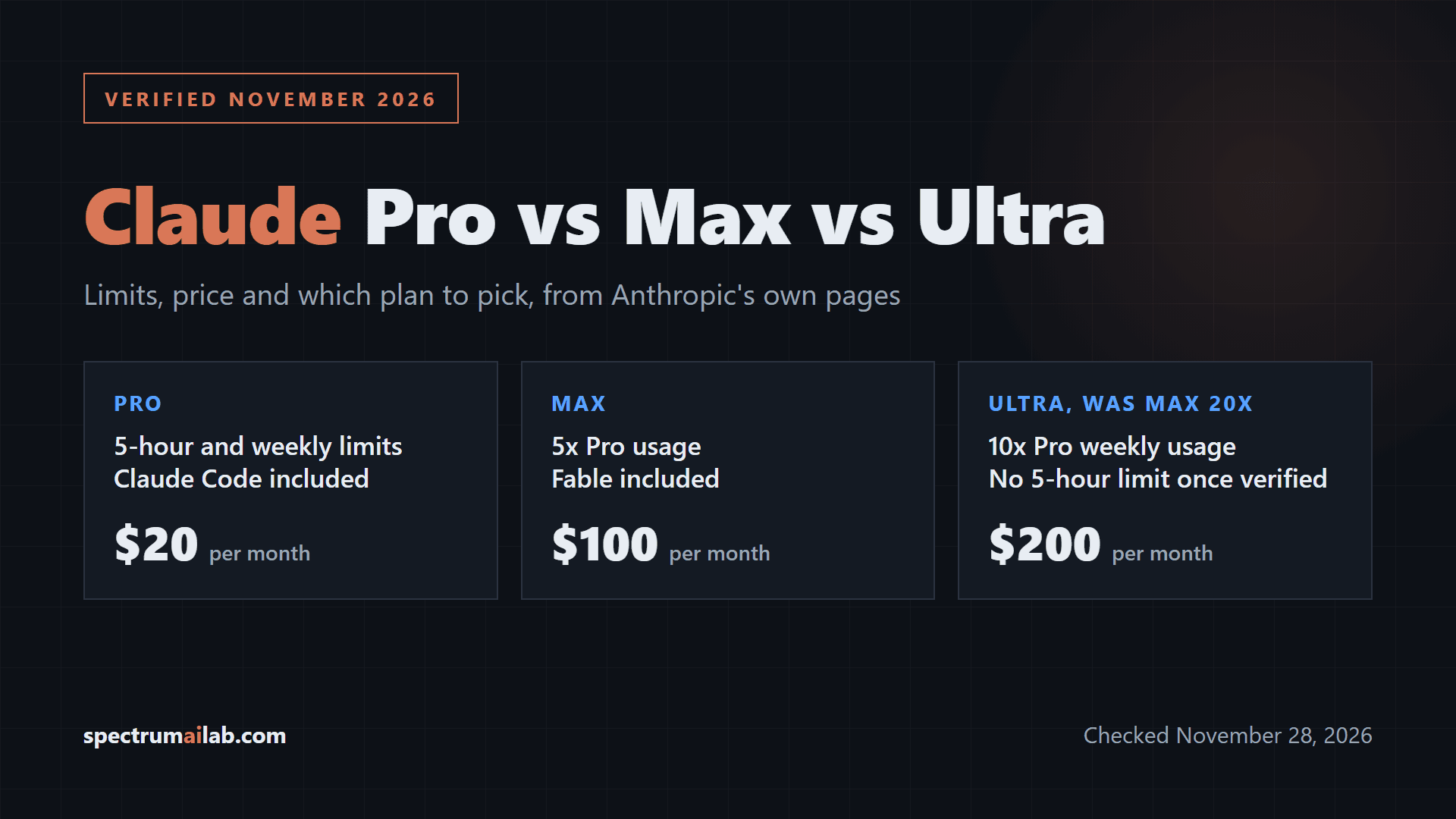
Do not read the pairs as equal. Google counts usage in compute and tells you its limits are 5x or 20x those of AI Pro. Claude measures its plans against Claude Pro and has its own 5-hour and weekly limits. Those units are not the same, so I make no claim that one plan gives more. My Claude Pro vs Max vs Ultra guide explains Claude's side in detail.
Per Arneng (@per_arneng) posted on November 25: "I got AI Ultra as well, cancelled my Claude MAX but have a week left." The post goes on: "Will evaluate antigravity but currently it looks good. Hard to beat all the things you get with that deal." It says "AI Ultra" but not which Ultra level (5x or 20x) or what it cost, so I add none. That is one person swapping one plan for the other.

Which should you pick?
It depends on the job, so use both if you can.
I do not think either model wins overall, and Google's table is Google's. Here is how I would choose, using only the facts above. If you are still deciding which model fits which task, my task-by-task model guide goes through it.
Neon or Opus 5.5, by situation
- 1API user watching cost per token: Neon is 25% cheaper on both input and output (our math). Run your own task on both and compare cost per finished task, not just the token price.
- 2Heavy batch or background work: Batch is $1.50 / $7.50 on Neon and $2 / $10 on Opus 5.5. The gap is the same 25% (our math).
- 3Very long outputs: Neon can output up to 1M tokens with background long decode. Opus 5.5 outputs up to 128K in a normal request, and Anthropic lists up to 300K on its Batch API with a beta setting. Both have a 1M token context window.
- 4Newer knowledge: Opus 5.5 has a June 2026 cutoff and Neon has March 2026. That matters if your task needs recent facts.
- 5Already paying for Claude Pro at $20: Opus 5.5 is included. Google AI Pro at $19.99 is the cheapest paid way to get Neon in the Gemini app.
- 6Not sure: try one real task on each. One test on X had Opus 5.5 ahead on score, and Google's table has Neon ahead on most rows. Both can be true for different work.
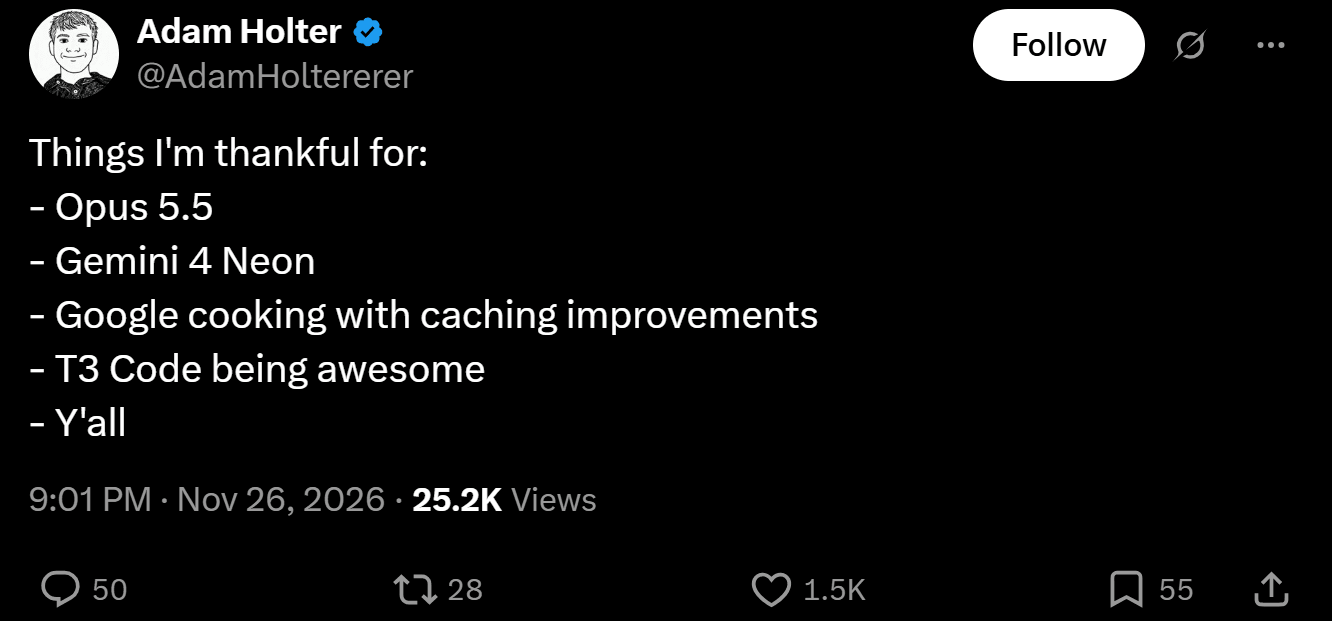
Plenty of people do not choose. On November 26, Adam Holter (@AdamHoltererer) posted a thankful list that includes both Opus 5.5 and Gemini 4 Neon, plus Google's caching improvements. That is one person, but it fits the plain advice: pick the model per job.
Sources
Official pages first.
- Google: Introducing Gemini 4 Neon (November 18, 2026, updated November 23)
- Google DeepMind: Gemini 4 Neon model card
- Google DeepMind: Gemini 4 Neon evals methodology
- Google AI Studio pricing and Gemini 4 Neon model page
- Gemini app limits help page
- Google AI plans (US), checked November 29, 2026
- Anthropic: Claude Opus 5.5, Anthropic: models overview and pricing docs
- Anthropic: Claude Fable 5.2 launch post
- claude.com/pricing
Posts on X, used only as examples of single runs and opinions. Every price and benchmark above comes from the official pages.
- News from Google (@NewsFromGoogle), November 21, 2026
- Shokhrukh Karimov (@shokhkarim1212), November 24, 2026, and Dakota (@byteotter), November 24, 2026
- OmedTheVibeCoder (@OmedVibeCodes), November 26, 2026
- Sree (@srikanthvaluri), November 28, 2026
- Per Arneng (@per_arneng), November 25, 2026
- Adam Holter (@AdamHoltererer), November 26, 2026
- My own posts: Claude Pro vs Max vs Ultra, AI API price index, Which AI model to use and Gemini 3.8 Flash guide
FAQ
Gemini 4 Neon vs Opus 5.5: which one is better?
Neither is better overall. On Google's own benchmark table, Opus 5.5 leads on two rows, Terminal-bench 4.1 (65.8 vs 65.2) and FrontierCode 2.0 (47.3 vs 46.2), and Neon leads on every other row where Opus 5.5 has a score. Those are Google's numbers, not independent ones. Per token, Neon is 25% cheaper (our math): $3/$15 vs $4/$20 per 1M tokens. The best test is to run your own task on both.
What is the Gemini 4 Neon price?
Gemini 4 Neon costs $3 per 1M input tokens and $15 per 1M output tokens on the standard Gemini API. The output price includes thinking tokens. Batch and Flex cost $1.50 input and $7.50 output, and Priority costs $5.40 input and $27 output. Cached input is $0.15 on standard. Opus 5.5 is $4 input and $20 output.
How much does Gemini 4 Neon cost to use?
It depends on how many tokens your task uses. As an example (our math), a job with 1M input tokens and 200K output tokens costs $6 on Neon and $8 on Opus 5.5 at standard prices. A model that thinks longer or needs more turns can cost more per task even with a lower token price, so test your own workload.
Is there a Gemini 4 Neon subscription?
Yes, through Google's AI plans. In the US, Google AI Pro is $19.99 a month and lists access to Gemini 4 Neon. Google AI Ultra starts at $99.99 a month and lists the highest access to Neon. Google AI Plus at $4.99 a month lists Gemini 4 Hydrogen only, and Free does not name a Gemini 4 model. Prices are US prices and differ by country.
What are the Gemini 4 Neon benchmarks?
Google published a table comparing Neon with Claude Opus 5.5 and GPT-6.2 Sol. For example, Neon scores 61 on the AA Index v5.0.1 vs 59 for Opus 5.5, 65.4% on CursorBench 4.1 vs 58.1%, and 95.2% on GraphWalks (256K to 1M) vs 66.8%. Opus 5.5 leads on Terminal-bench 4.1 and FrontierCode 2.0. These are Google's own numbers, not independent results.
Gemini 4 Neon vs Claude: how do they compare?
Neon is Google's model and Claude is Anthropic's family of models. The closest match is Claude Opus 5.5, which costs $4/$20 per 1M tokens vs $3/$15 for Neon. Both have a 1M token context window. Opus 5.5 can output up to 128K tokens, and Neon outputs 64K by default and up to 1M with background long decode. Claude's top model, Fable 5.2, costs $8/$40.
Gemini 4 Neon vs Carbon: what is the difference?
Google positions Carbon for the hardest long-horizon work and Neon for complex, high-frequency workflows that need to be faster and cheaper. Neon was adapted from Carbon. Google says Neon costs about 32% less per task than Carbon at default thinking on the Artificial Analysis Index. Carbon's intro price of $2/$10 ends November 30. From December 1 it is $4/$20, which makes Neon the cheaper of the two.
Gemini 4 Neon vs Hydrogen: which should I use?
Hydrogen is Google's model for fast everyday tasks. It costs $1.50/$7.50 per 1M tokens, has a free tier, and is the only Gemini 4 model on the US Google AI Plus plan. Neon costs $3/$15, has no free API tier, and needs Google AI Pro or higher in the Gemini app. In one person's single test on X, Hydrogen finished a task in 5 minutes and Neon in 15, with different settings.
Gemini 4 Neon vs Fable 5.2: which is better?
There is no direct comparison. Anthropic's launch post for Fable 5.2 compares it with Gemini 4 Carbon, not Neon. Fable 5.2 costs $8/$40 per 1M tokens, and Neon costs $3/$15. I have no benchmark that puts the two side by side, so I make no claim about which is better.
Is Gemini 4 Neon free?
No. Google's AI Studio pricing page says Neon is not available on the Free tier of the API. In the Gemini app it is not on Free or Google AI Plus. You need Google AI Pro, which is $19.99 a month in the US, or Google AI Ultra. College students get a free Pro plan for one year, according to a banner on Google's plans page.

Founder of Spectrum AI Labs, testing AI tools and models, and writing up what actually ships.
More about Paras →Stay ahead of the AI curve
We test new AI tools every week and share honest results. Join our newsletter.