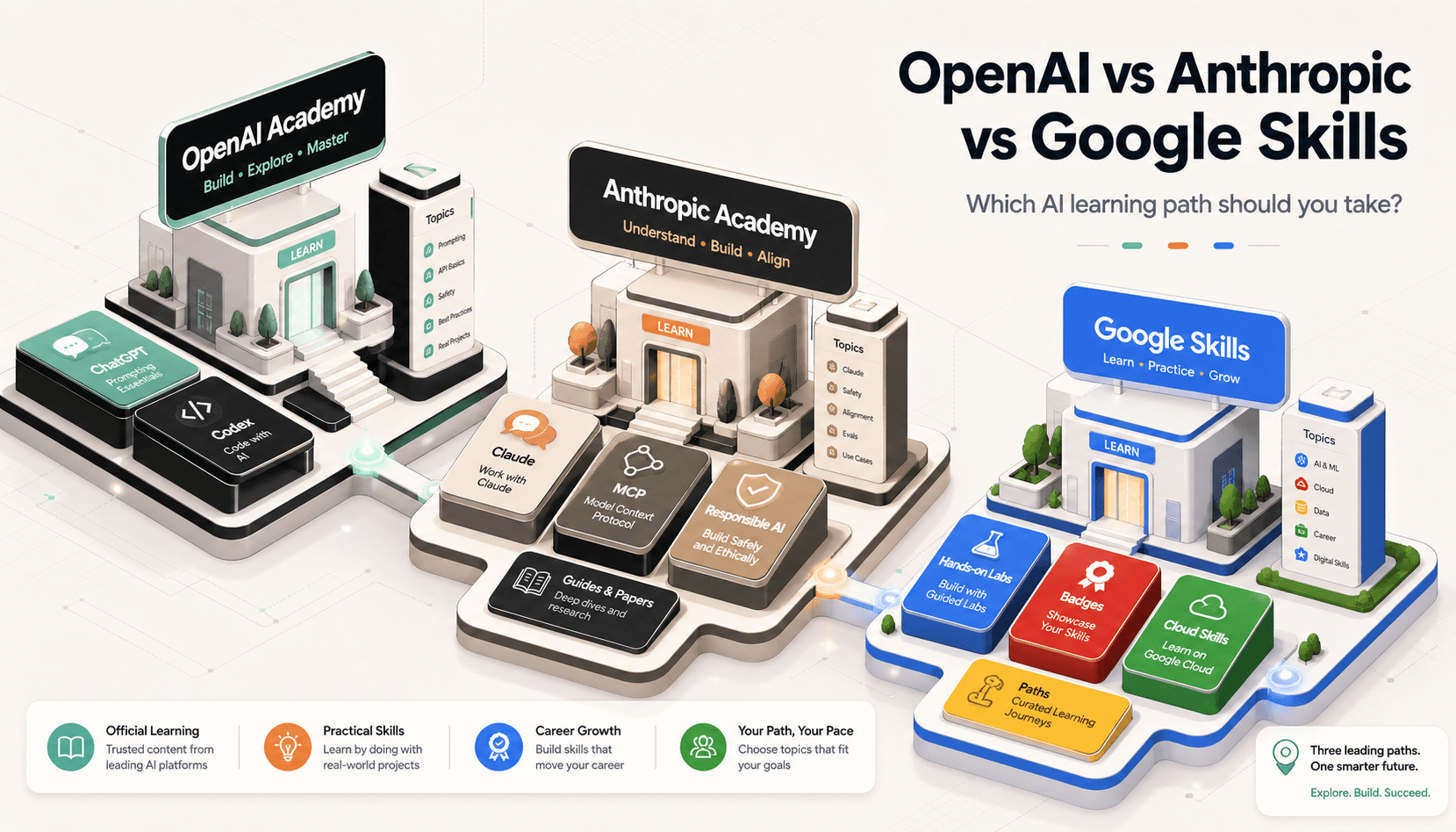
![Claude Academy: All 22 Free Courses Ranked [2026]](/_next/image?url=%2Fimages%2Fclaude-academy-learning-background-2026.png&w=3840&q=75)
Claude Academy is Anthropic's rebuilt learning site. It had 355 resources when I checked it on August 22, 2026: 22 courses, 119 tutorials, 148 use cases and 66 webinars. Start with Claude 101 for everyday work, Claude Code 101 for coding, Claude Platform 101 for the API, or AI Fluency: Framework & Foundations for broader AI skills. You can read public lessons without signing in. Sign in with a Claude account to save progress, have quizzes graded and earn a completion badge. The current reward is a badge, not the certificate offered by the older Skilljar Academy and not an Anthropic professional certification.
The short answer
Pick one course. Use the rest of the library when you need it.
Claude Academy is now much more than a list of Anthropic courses. Anthropic moved from a 20-course Skilljar catalog to a searchable learning site with courses, short tutorials, job-specific use cases and webinars.
Take Claude 101 if you use Claude for normal office work. Take Claude Code 101 if you write code. Take Claude Platform 101 if you build with the API. Take AI Fluency: Framework & Foundations if you teach, manage a team or decide how AI should be used at work.
- The live catalog contains 355 resources: 22 courses, 119 tutorials, 148 use cases and 66 webinars
- Public lessons can be read without signing in
- A Claude account is needed to save progress, have quizzes graded and receive a completion badge
- Claude 101 is 2.5 hours; Claude Code 101 is 1 hour; Claude Platform 101 is 1.5 hours
- Building with the Claude API is the longest general developer course at 9 hours
- The current site awards completion badges, while the older Skilljar Academy used completion certificates
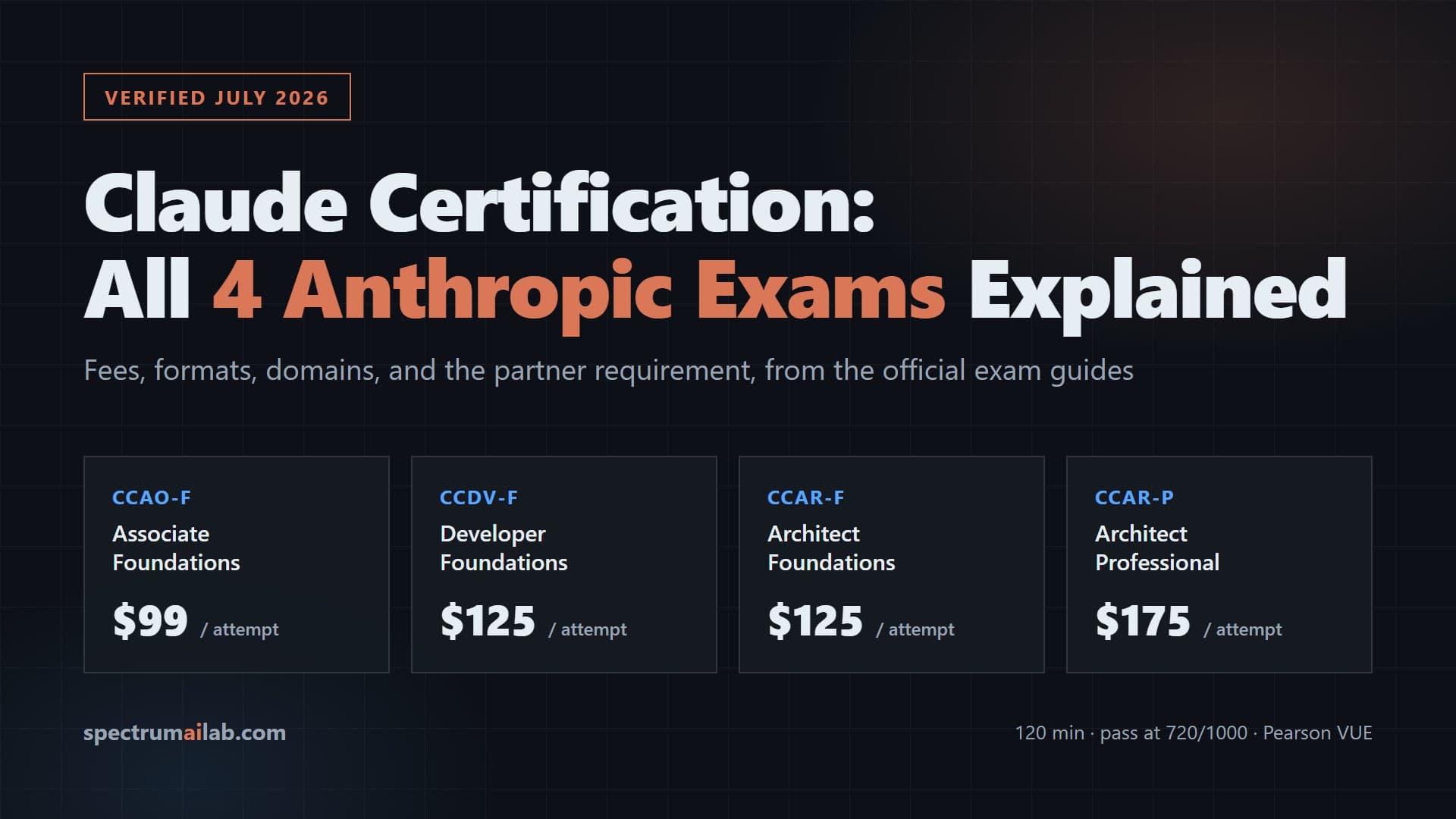
- Academy badges are separate from Anthropic's paid, exam-based professional certifications
- The catalog includes product-neutral AI Fluency material as well as training for Claude products
What changed in the new Claude Academy
The old article needed more than a new course count.
Old Anthropic Academy vs the current Claude Academy
| Before August 20 | Current site | |
|---|---|---|
| Name | Anthropic Academy | Claude Academy |
| Home | anthropic.skilljar.com | academy.claude.com |
| Library | 20 public courses in July | 355 total resources |
| Content types | Courses | Courses, tutorials, use cases and webinars |
| Course count | 20 | 22 |
| Progress account | Separate Skilljar account | Claude account |
| Completion reward | Certificate language | Completion badge |
| Course length | Not shown on public landing pages | Shown in the catalog and on course pages |
Source: Live Claude Academy and legacy Anthropic Skilljar pages, checked August 22, 2026
Anthropic announced the rebuilt site on August 20. The company says the lessons borrow from the way it trains its own employees, including the 4D AI Fluency Framework: Delegation, Description, Discernment and Diligence. In plain English, that means deciding what AI should do, explaining the job well, judging the output and taking responsibility for the result.
The catalog also has a Claude Academy Skill. Install it in Claude and it can recommend courses or learning paths based on your work. The official announcement says the site can also be opened from the “Learn more” option in a Claude profile.
Do not publish the old numbers
Search results still contain articles calling this a 13-, 14-, 18- or 20-course academy. Those numbers describe older versions. The live Claude Academy showed 22 courses and 355 total resources on August 22, 2026.
Is Claude Academy free?
The lessons are public. Accounts and product usage are separate.
You can read Claude Academy's public lessons without paying or signing in. I opened the first Claude 101 lesson while signed out. The page explicitly said I could keep reading, but my completed lessons would not be saved.
You need to sign in with a Claude account if you want progress tracking, graded quizzes and a completion badge. The badge page says the quiz is graded on your account and the badge is issued to that account.
Free course access does not make every exercise free. Claude 101 says a Claude account on any plan is enough to begin, but it also identifies Cowork and Enterprise Search as paid or Team/Enterprise features. API, Amazon Bedrock and Google Cloud exercises can create usage charges outside the Academy.
Which Claude Academy course should you take first?
Choose the path that matches the work in front of you.
Best Claude Academy path by role
| Your goal | Start here | Take next | Only if needed |
|---|---|---|---|
| Use Claude at work | Claude 101 | AI Fluency: Framework & Foundations | Introduction to Claude Cowork |
| Code with Claude | Claude Code 101 | Claude Code in Action | Agent skills, then subagents |
| Build with the API | Claude Platform 101 | Building with the Claude API | MCP courses |
| Build an MCP integration | Claude Platform 101 | Introduction to MCP | MCP: Advanced Topics |
| Lead AI adoption | AI Fluency: Framework & Foundations | Claude 101 | A role-specific AI Fluency course |
| Teach adults | AI Fluency: Framework & Foundations | Teaching AI Fluency | AI Fluency for educators |
| Teach pK-12 | AI Fluency for pK-12 Educators | pK-12 Train the Trainer | Teaching AI Fluency |
| Deploy through AWS | Claude Platform 101 | Claude with Amazon Bedrock | Building with the Claude API |
| Deploy through Google Cloud | Claude Platform 101 | Claude with Vertex AI | Building with the Claude API |
Source: Editorial order based on official course descriptions, prerequisites and current lengths
If you only want one recommendation, take Claude 101. It is the broadest introduction and now covers much more than prompting: Projects, Artifacts, Skills, Connectors, Enterprise Search, Research, Cowork, Claude Code, Claude Tag, Claude Design, Microsoft 365 and Claude in Chrome. It takes 2.5 hours.
Developers should not begin with the nine-hour API course. Claude Platform 101 gives you the map in 1.5 hours. If the work still matters after that, take Building with the Claude API. Claude Code users have an even shorter starting point: Claude Code 101 takes one hour.
All 22 Claude Academy courses ranked
The ranking favors broad usefulness, sensible prerequisites and time-to-value.
Claude Academy course list
| Rank | Course | Time | Best for |
|---|---|---|---|
| 1 | Claude 101 | 2.5 hr | Anyone using Claude for everyday work |
| 2 | Claude Code 101 | 1 hr | Developers new to Claude Code |
| 3 | Claude Platform 101 | 1.5 hr | Developers new to the Claude API platform |
| 4 | AI Fluency: Framework & Foundations | 4 hr | People making decisions about AI use |
| 5 | Claude Code in Action | 1 hr | Developers running longer Claude Code tasks |
| 6 | Introduction to Claude Cowork | 2.5 hr | People handing multi-step office work to Claude |
| 7 | Building with the Claude API | 9 hr | Developers building production Claude applications |
| 8 | AI Capabilities and Limitations | 3.5 hr | People who want an accurate mental model of AI |
| 9 | Introduction to Model Context Protocol | 1 hr | Developers connecting Claude to tools and data |
| 10 | Introduction to agent skills | 1 hr | Claude Code users creating reusable instructions |
| 11 | Introduction to subagents | 45 min | Claude Code users splitting up complex work |
| 12 | Model Context Protocol: Advanced Topics | 1.5 hr | Developers taking MCP beyond the basics |
| 13 | AI Fluency for Builders | 3 hr | Product builders moving from problem to shipped work |
| 14 | AI Fluency for Small Businesses | 4 hr | Owners and staff applying AI to daily operations |
| 15 | AI Fluency for educators | 1.5 hr | Faculty and instructional designers |
| 16 | AI Fluency for students | 3 hr | Students using AI for learning and career planning |
| 17 | AI Fluency for nonprofits | 4 hr | Nonprofit research, writing and operations |
| 18 | AI Fluency for pK–12 Educators | 3 hr | School educators; made with Teach For America |
| 19 | Teaching AI Fluency | 4.5 hr | People teaching and assessing the 4D framework |
| 20 | AI Fluency for pK-12 Train the Trainer | 45 min | Educators training other educators |
| 21 | Claude with Amazon Bedrock | 8 hr | Teams deploying Claude on AWS |
| 22 | Claude with Google Cloud's Vertex AI | 8.5 hr | Teams deploying Claude on Google Cloud |
Source: Live Claude Academy course catalog, checked August 22, 2026
Finished Claude Code 101? Put it into practice with a clean Claude Code setup.
The two cloud courses are last because they are specialised, not because they are weak. If your company already runs Claude through Bedrock or Vertex AI, move the matching course near the top. Everyone else can skip both.
The other 333 resources may be more useful
Use a course for foundations and a short resource for the task you have today.
The 22 courses get the obvious search traffic, but they are only 6% of the library. Claude Academy also lists 119 tutorials, 148 use cases and 66 webinars.
- Tutorials teach one action. They are a better fit when you need to create an Artifact, set up a Skill or understand one AI concept without taking a full course.
- Use cases begin with a job. The live catalog includes short tasks such as account research and account tracking, both listed at 10 minutes.
- Webinars cover current product workflows and customer examples. They age faster than the courses, so check the date before watching.
This structure is the most useful part of the relaunch. A course teaches the system. A tutorial answers “how do I do this?” A use case answers “how can this help with my job?” Those are different questions, and the new Academy no longer forces them into the same format.
Does Claude Academy give a certificate?
The current site gives a completion badge.
Claude Academy now calls the course reward a completion badge. Course pages show “Completion badge,” and the badge flow asks you to sign in so the quiz can be graded and the badge can be issued to your Claude account.
The older Skilljar-hosted Anthropic Academy used the phrase “completion certificate.” That is why older articles, screenshots and search snippets still promise certificates. They were describing the previous platform.
Badge, certificate and certification are not interchangeable
A Claude Academy completion badge shows that you finished a course. The old Skilljar completion certificate showed the same kind of course completion. Anthropic's professional certifications are separate exams with their own price, rules and credential. Read our Claude certification guide before putting any of them on a résumé.
Is Claude Academy worth it?
Yes, but completing the whole catalog would be a terrible goal.
Claude Academy is worth using because the material is official, public and unusually specific. The course pages state the lesson count, quiz count and expected time. The tutorials and use cases let you skip directly to a real task.
Experienced users may already know most of the material in their track. A completion badge proves that you finished Anthropic's material. It does not prove that you can design a production agent, audit an AI workflow or teach a team.
A sensible way to use Claude Academy
- 1Choose one foundation course that matches your work.
- 2Finish its exercises instead of passively reading every page.
- 3Use tutorials when you get stuck on one feature.
- 4Use job-specific use cases when you need an example you can adapt.
- 5Take an advanced course only after you have a project that needs it.
- 6Treat the badge as a record of study, then show the work you built with it.
Start with Claude 101, Claude Code 101, Claude Platform 101 or AI Fluency: Framework & Foundations. Do one useful project. Return to the Academy when that project gives you a more specific question.
How I checked Claude Academy
Counts and access rules came from the live site, not recycled launch coverage.
I opened the Claude Academy home page and full catalog while signed out on August 22, 2026. I checked each content filter separately, which produced 22 courses, 119 tutorials, 148 use cases and 66 webinars. Together they match the catalog's 355-resource total.
I then opened the Claude 101 course page, its first lesson and its completion badge page. The lesson remained readable while signed out. The site said sign-in was required to save progress, grade the quiz and issue the badge. I also checked the current course names, lesson counts, quiz counts and durations against the live catalog.
Course rankings are editorial judgement. Catalog counts, durations, access rules and badge language are observed facts. The catalog changes often, so the date beside each fact matters.
Official sources checked
Start with Anthropic's own pages.
- Claude Academy home
- Claude Academy full resource catalog
- Claude 101 course page
- Claude 101 public lesson
- Claude 101 completion badge page
- Anthropic's August 20 Claude Academy announcement
- Legacy Anthropic Academy catalog on Skilljar
FAQ
What is Claude Academy?
Claude Academy is Anthropic's official learning site for AI fundamentals and Claude products. On August 22, 2026, its live catalog contained 355 resources: 22 courses, 119 tutorials, 148 use cases and 66 webinars.
Is Claude Academy free?
Yes. The catalog and lessons I checked were publicly readable without payment or sign-in. A Claude account is required to save progress, grade quizzes and receive a completion badge. Some hands-on exercises use Claude features, API calls or cloud services that may cost money.
How many Claude Academy courses are there?
Claude Academy listed 22 courses on August 22, 2026. The larger 355 figure includes tutorials, use cases and webinars as well.
What is the best Claude Academy course?
Claude 101 is the best general starting point. Claude Code 101 is best for coding, Claude Platform 101 is best for API development, and AI Fluency: Framework & Foundations is best for managers and educators.
Does Claude Academy give a certificate?
The current Claude Academy gives a completion badge. The older Skilljar Academy used completion certificate language. Neither should be confused with Anthropic's separate professional certification exams.
Can I use Claude Academy without an account?
Yes. Public lessons can be read without an account. Your progress will not be saved, quizzes will not be graded to your account and you will not receive a completion badge.
Is Claude Academy worth it?
Yes, if you take one relevant course and apply it. Do not try to finish all 355 resources. Use the tutorials and use cases when a real task gives you a reason to return.

Founder of Spectrum AI Labs — testing AI tools and models, and writing up what actually ships.
More about Paras →Stay ahead of the AI curve
We test new AI tools every week and share honest results. Join our newsletter.