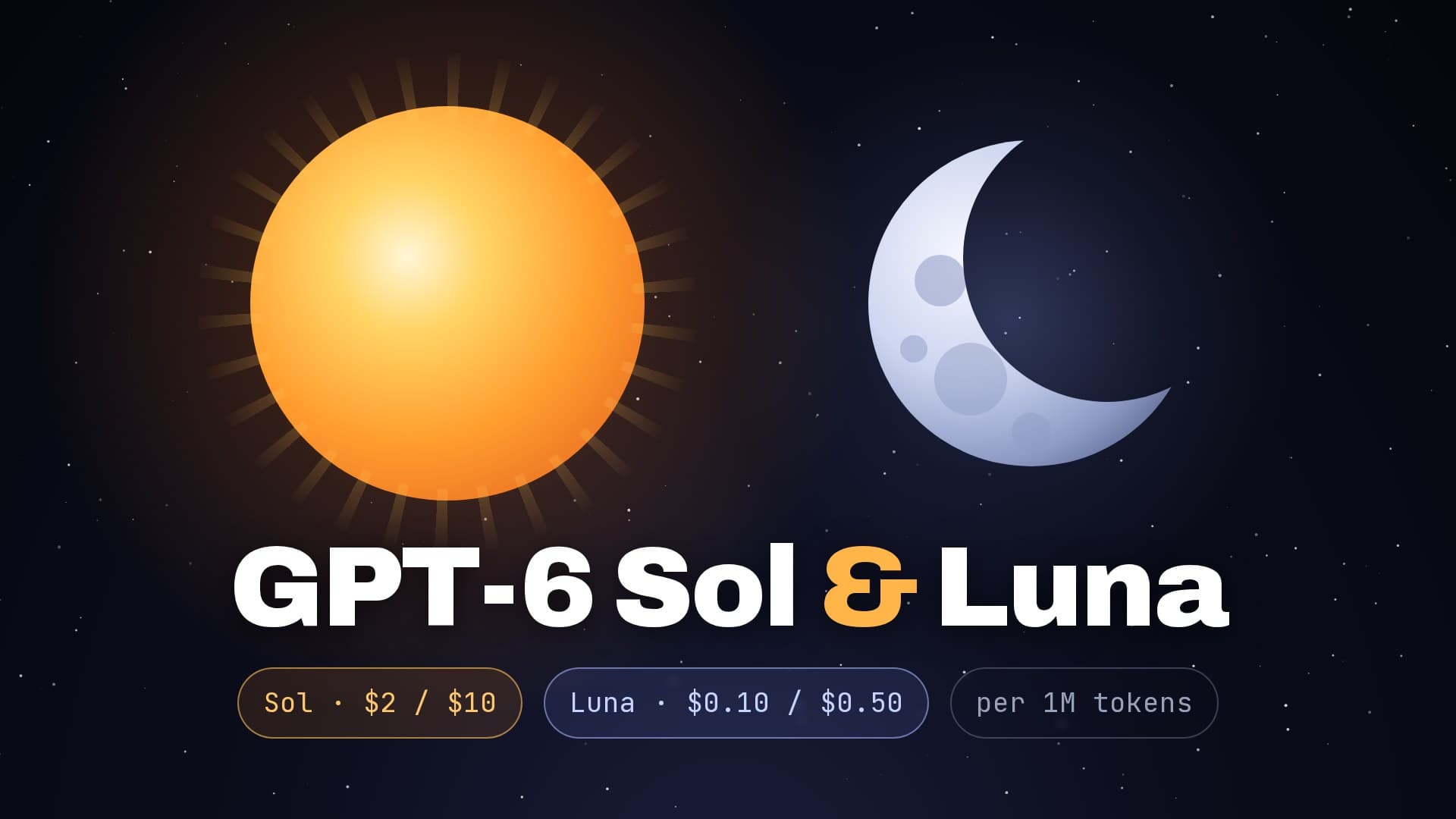
GPT-6 Sol costs $2 input and $10 output per million tokens. GPT-6 Luna costs $0.10 and $0.50. That is roughly half of what the GPT-5.6 versions cost, and independent tests so far put the quality about level with GPT-5.6. So this launch is mostly a price cut, and a big one. Use Sol for coding and agent work, use Luna for high-volume jobs like extraction and summaries, and watch out for prompts over 272K tokens, which are billed at a higher rate for the whole request.
- OpenAI released GPT-6 Sol (gpt-6-sol) and GPT-6 Luna (gpt-6-luna) on September 22, 2026, in the API, ChatGPT and Codex.
- Sol: $2 input and $10 output per million tokens for prompts up to 272K tokens. Cached input is $0.20.
- Luna: $0.10 input and $0.50 output per million tokens up to 272K tokens. Cached input is $0.01.
- Both have a 1.05M-token context window and 128K maximum output, with reasoning effort from none up to max.
- OpenAI says Sol makes about half as many mistakes as its predecessor on its internal factuality evaluation.
- Artificial Analysis measured intelligence scores roughly level with GPT-5.6 and about half the cost per task.
GPT-6 Astra got the headlines at the start of September. It is OpenAI's most capable model and it is priced like it, at $10 input and $50 output per million tokens. Sol and Luna arrived three weeks later with much less noise, and for most people paying an OpenAI bill they matter more. OpenAI describes them as bringing much of Astra's strengths into faster, cheaper models. The price part of that claim is easy to check. The capability part deserves more skepticism, because the independent numbers so far are less exciting than OpenAI's.
What OpenAI launched
Astra on top, then Sol and Luna. The middle tier is gone.
GPT-5.6 came in three sizes: Sol, Terra and Luna. GPT-6 drops the middle one. You get Astra at the top, Sol for complex coding and agent work, and Luna, which OpenAI calls its most efficient model for focused, high-volume tasks. There is no GPT-6 Terra.
Sol and Luna are built the same way on paper. Both take a 1.05M-token context window, return up to 128K output tokens, and accept six reasoning effort settings: none, low, medium, high, xhigh and max. Medium is the default. In the API they are gpt-6-sol and gpt-6-luna.
Nothing forces you to move yet. The GPT-5.6 models are still available and OpenAI has not announced a shutdown date for them.
GPT-6 Sol and Luna pricing
Half price across the board, and a bit better than half on Luna's output.
GPT-6 vs GPT-5.6 API pricing, per million tokens
| Model | Input | Cached input | Output |
|---|---|---|---|
| GPT-6 Astra | $10 | $1.00 | $50 |
| GPT-6 Sol | $2 | $0.20 | $10 |
| GPT-5.6 Sol (promotional) | $4 | $0.40 | $20 |
| GPT-5.6 Terra | $2 | $0.20 | $12 |
| GPT-6 Luna | $0.10 | $0.01 | $0.50 |
| GPT-5.6 Luna | $0.20 | $0.02 | $1.20 |
Source: OpenAI model pages and API pricing, standard rates for prompts up to 272K tokens. GPT-5.6 Sol's $4 / $20 is a promotional rate; its list price is $5 / $30.
Against GPT-5.6 Sol's promotional rate, GPT-6 Sol halves both input and output. Against GPT-5.6 Sol's $5 / $30 list price, the drop is even larger, and OpenAI guarantees that promotional rate only through November 21.
Luna's input is also half, but its output goes from $1.20 to $0.50, which is about 58% cheaper. If your Luna jobs write more than they read, you save more than the headline number suggests.
The comparison I find most telling is Sol against GPT-5.6 Terra. They have the same input price, and Sol is cheaper on output. Terra used to be the sensible middle option. Now the bigger model costs less.
Caching follows the same pattern as before. Cached input is 10% of the normal input price, and OpenAI lists cache writes at 1.25 times input. Batch and Flex run at half the standard rates.
Is the price permanent?
VentureBeat and other outlets report that OpenAI confirmed these are permanent prices rather than a promotion. OpenAI's own announcement describes the change as a 50% reduction compared with GPT-5.6 promotional pricing and does not give an end date. I would still check the pricing page before locking a yearly budget.
The 272K-token catch
Cross the line and the whole request is billed at the higher rate.
The 1.05M context window is real, but the price is not flat across it. Once a prompt goes over 272K tokens, OpenAI bills the entire request at a higher tier: twice the input and cache rates, and one and a half times the output rate.
Long-prompt pricing, per million tokens
| Model | Up to 272K tokens | Over 272K tokens |
|---|---|---|
| GPT-6 Sol | $2 / $10 | $4 / $15 |
| GPT-6 Luna | $0.10 / $0.50 | $0.20 / $0.75 |
| GPT-6 Astra | $10 / $50 | $20 / $75 |
Source: OpenAI API pricing. Input / output per million tokens.
On Sol, a 270K-token prompt costs about $0.54 in input. A 300K-token prompt costs about $1.20, because the extra 30K tokens push all 300K onto the $4 rate. If you run large-repo coding sessions or feed whole document sets into one request, measure how often you cross that line. Trimming context or leaning on caching may save more than switching models would.
Not sure which AI model to use?
20 models · Personalized picks · 60 seconds
How good are they?
OpenAI talks about fewer mistakes and lower cost. Independent tests say about the same capability as GPT-5.6.
OpenAI's launch post does not lead with a big benchmark jump. It leads with reliability. On OpenAI's internal factuality evaluation, built from real conversations where users flagged errors, GPT-6 Sol makes about half as many mistakes as its predecessor. OpenAI also says both models inherit Astra's writing style, with clearer wording, less jargon and slightly shorter answers.
The benchmark claims are about cost as much as quality. On AutomationBench, a test of business workflows, OpenAI says Sol at xhigh effort beats Claude Opus 5 at max effort for 9% of Opus 5's cost per task, and that Luna at high effort improves on its predecessor by 5.4 percentage points at 58% lower cost per task. It also says Luna at higher effort can match GPT-5.6 Sol at a small fraction of the cost.
The first independent numbers, from Artificial Analysis, are calmer. It puts both models roughly level with GPT-5.6 on its Intelligence Index, better on some evaluations and worse on others, at about half the cost per task: roughly $1.06 for Sol against $1.99 for GPT-5.6 Sol. It also measured a much lower hallucination rate for Sol, partly because Sol declines to answer more often.
My read
Treat GPT-6 Sol as GPT-5.6-class capability at about half the price, with better factual reliability. That is a very good deal for most workloads. Keep in mind that AutomationBench is OpenAI's own benchmark. Test it on your workload before you move production traffic.
Who can use GPT-6 Sol and Luna
Paid ChatGPT plans get both. Free users get Luna in the desktop app.
Where GPT-6 Sol and Luna are available
| Where | GPT-6 Sol | GPT-6 Luna |
|---|---|---|
| OpenAI API | Yes (gpt-6-sol) | Yes (gpt-6-luna) |
| ChatGPT Plus, Pro, Business, Enterprise, Edu | Yes, in ChatGPT Work and Codex | Yes, in ChatGPT Work and Codex |
| ChatGPT Free and Go | No | Yes, in the desktop app |
| GitHub Copilot | Pro+, Max, Business, Enterprise | Pro, Pro+, Max, Business, Enterprise |
Source: OpenAI announcement and ChatGPT release notes; GitHub changelog for Copilot. Rollout started September 22, 2026.
OpenAI rolled access out gradually on launch day, so if the models are missing from your picker, give it a few hours. On Enterprise workspaces an admin has to switch new models on before anyone sees them.
Sol or Luna: which should you use?
The more clearly you can define the task, the more likely Luna is enough.
Pick by task
- 1Coding, code review, debugging and agent loops: GPT-6 Sol. This is the job OpenAI built it for.
- 2Research and analysis that needs several reasoning steps: GPT-6 Sol at medium or high effort.
- 3Extraction, classification, tagging and summaries at volume: GPT-6 Luna. At $0.10 / $0.50 it is priced like a budget open-weight model.
- 4Support drafts and simple question answering: GPT-6 Luna, with Sol reserved for escalations.
- 5The hardest, highest-stakes work where cost matters less: GPT-6 Astra, if your organization has it enabled.
Don't assume higher effort is better. Vellum's early AutomationBench runs found Sol scored slightly lower at max than at xhigh while costing more, and Luna did slightly better at high than at xhigh. I would start at the default, medium, and only step up when your own evals show a gain.
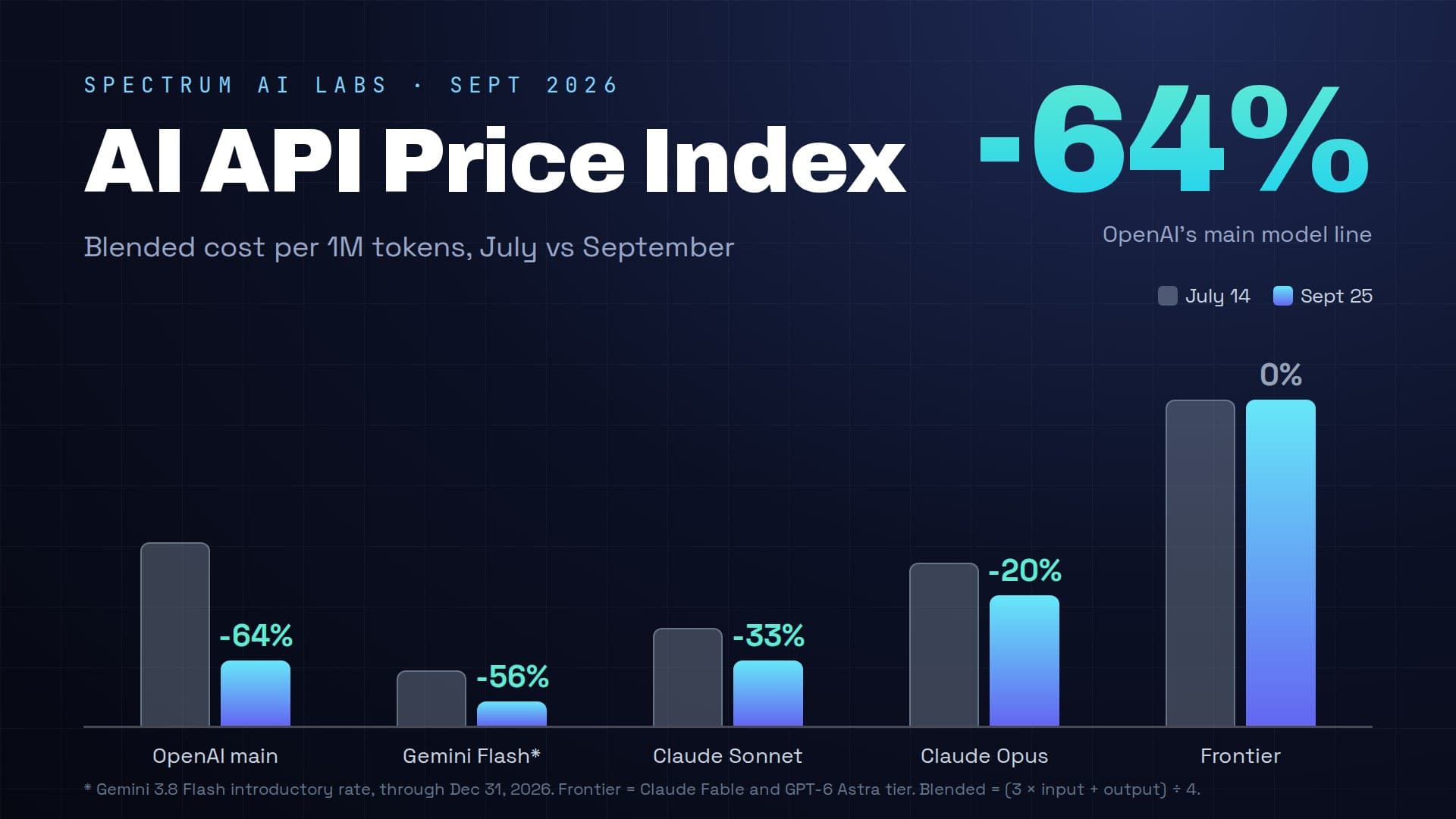
For how Sol and Luna stack up against Claude, Gemini and the open-weight models task by task, see our model guide. For every provider's prices side by side, see the AI API price index, and to estimate your own monthly bill, use the AI cost calculator.
Should you switch from GPT-5.6?
For most API users, yes, after a short eval.
If you run GPT-5.6 Sol, the case is simple. You get similar capability for about half the price and, by OpenAI's measure, fewer factual errors. OpenAI guarantees GPT-5.6 Sol's promotional rate only through November 21, 2026, so its long-term price is also less certain than Sol's.
If you run GPT-5.6 Luna, GPT-6 Luna cuts your output bill by more than half. One caution: Artificial Analysis found the new Luna slightly weaker than the old one on some coding-agent tests. If you use Luna for code, compare the two before you switch.
If you mostly use ChatGPT rather than the API, there is nothing to do. The new models show up in ChatGPT Work and Codex as the rollout reaches your account.
How this guide was sourced
Prices, model specs and availability come from OpenAI's announcement, model pages and pricing page, with GitHub's changelog for Copilot. Performance claims are OpenAI's unless they are marked as Artificial Analysis. I have not run my own benchmark of these models. Facts were checked on September 25, 2026.
Sources
- OpenAI: Introducing GPT-6 Sol and Luna
- OpenAI: GPT-6 Sol model page
- OpenAI: GPT-6 Luna model page
- OpenAI: API pricing
- OpenAI: GPT-6 Astra
- OpenAI: ChatGPT release notes
- GitHub changelog: GPT-6 Sol and GPT-6 Luna now available
- Artificial Analysis: GPT-6 Sol and Luna push the cost-efficiency frontier
- Vellum: GPT-6 Sol and Luna benchmarks explained
- VentureBeat: OpenAI releases GPT-6 Sol and Luna
- TechCrunch: OpenAI launches GPT-6 Sol and Luna
FAQ
How much does GPT-6 Sol cost?
GPT-6 Sol costs $2 per million input tokens and $10 per million output tokens for prompts up to 272K tokens, with cached input at $0.20. Prompts longer than 272K tokens are billed at $4 input and $15 output for the whole request. That is half of GPT-5.6 Sol's promotional $4 and $20 rate.
What is the difference between GPT-6 Sol and GPT-6 Luna?
Sol is the stronger model, built for complex coding and agent work. Luna is OpenAI's most efficient model, meant for focused, high-volume jobs like summarization, extraction and simple questions. Both have a 1.05M-token context window and 128K maximum output. Luna costs one twentieth of Sol per token: $0.10 input and $0.50 output per million tokens.
Can free ChatGPT users use GPT-6?
Partly. OpenAI says Free and Go users can use GPT-6 Luna in the ChatGPT desktop app. GPT-6 Sol and Luna are in ChatGPT Work and Codex for Plus, Pro, Business, Enterprise and Edu users, rolled out gradually from September 22, 2026. Enterprise admins need to enable new models for their workspace.
Is there a GPT-6 Terra?
No. OpenAI released only Sol and Luna in the GPT-6 family on September 22, alongside the larger GPT-6 Astra from earlier in September. GPT-5.6 Terra is still available at $2 input and $12 output per million tokens, and no shutdown date has been announced for the GPT-5.6 models.
Should I switch from GPT-5.6 to GPT-6 Sol?
For most API workloads, yes, after a short test. Sol costs half of GPT-5.6 Sol's promotional rate and OpenAI reports fewer factual mistakes. Artificial Analysis found overall scores roughly level with GPT-5.6, so the gain is mainly cost. Run your own evals first, especially if you send prompts longer than 272K tokens.

Founder of Spectrum AI Labs — testing AI tools and models, and writing up what actually ships.
More about Paras →Stay ahead of the AI curve
We test new AI tools every week and share honest results. Join our newsletter.