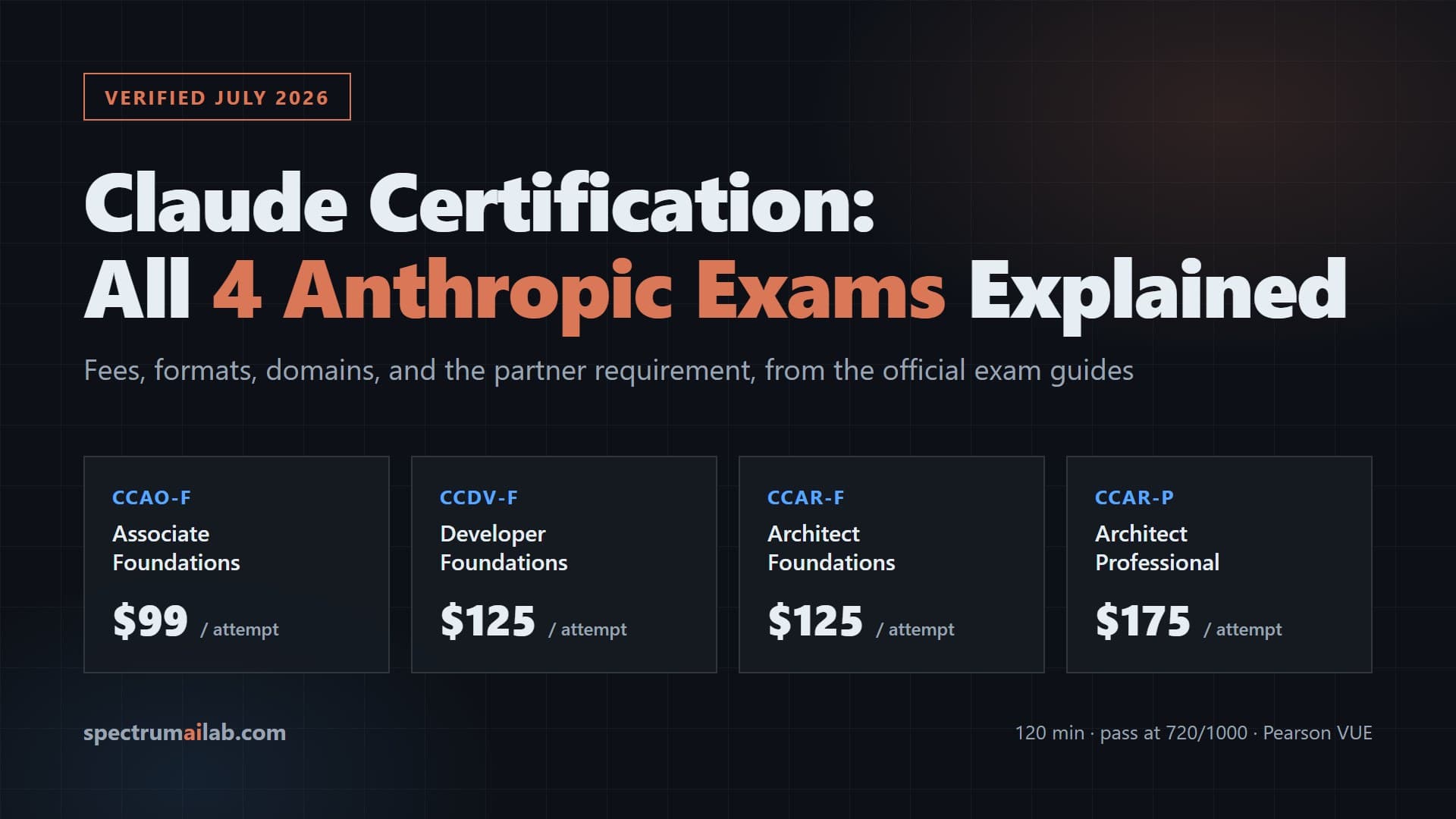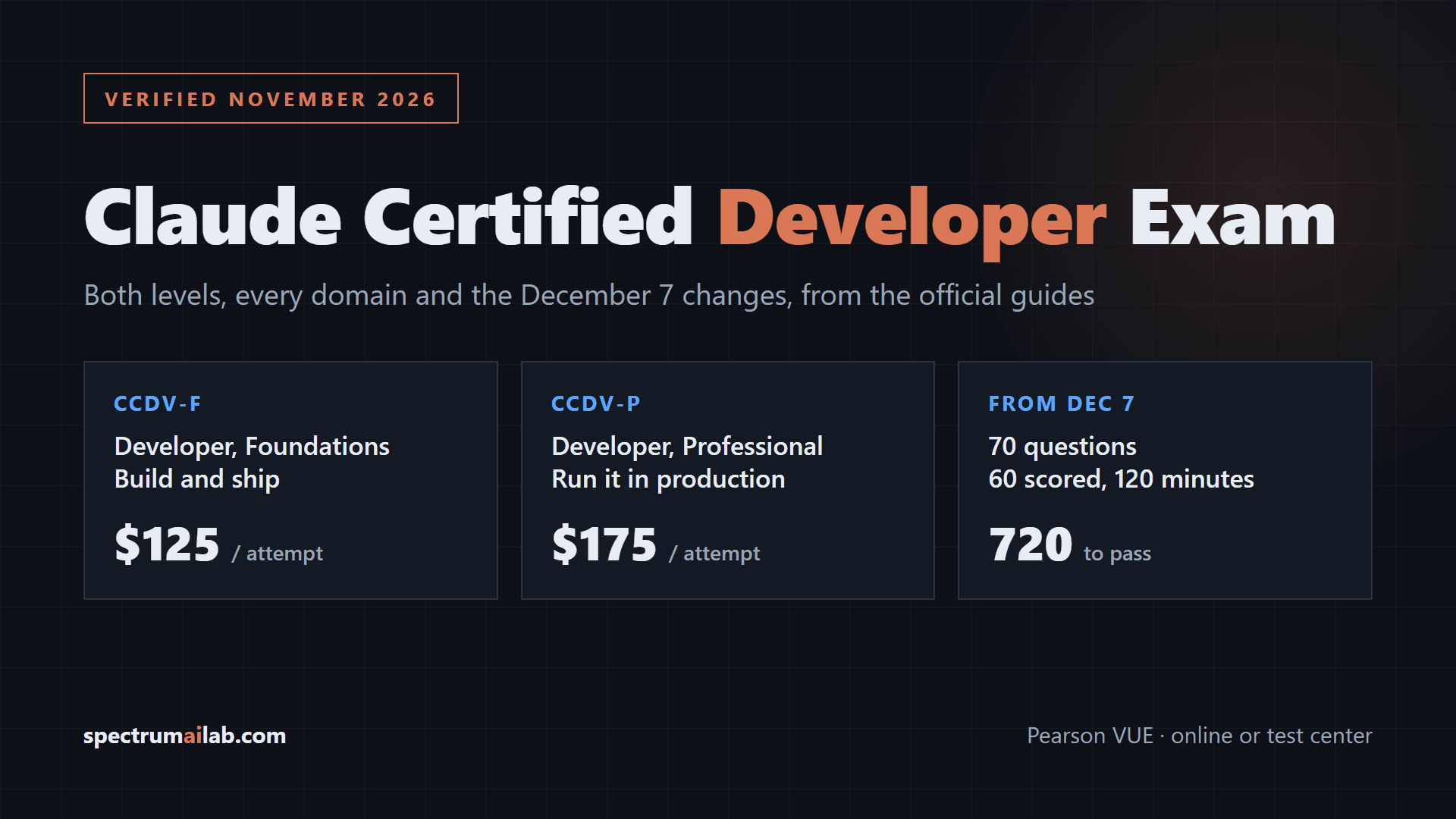
The Claude Certified Developer exam comes in two levels. Developer, Foundations (CCDV-F) costs $125 and checks that you can build and ship Claude applications. Developer, Professional (CCDV-P) costs $175 and checks that you can run them in production. From December 7, 2026 both have 70 questions (60 scored) in 120 minutes, and both pass at 720 on a 100 to 1,000 scale. Foundations changes that day: it goes from 53 questions to 70, every question becomes a scenario, and evals, Claude Code and prompt and context engineering gain weight. Only people at Claude Partner Network organizations can register. Everything below comes from Anthropic's exam guides, which are the official rulebooks.
Both Developer levels at a glance
Same time limit and passing bar, different job.
Anthropic runs two Developer exams, and neither requires the other. Both exams are proctored by Pearson VUE, and you can take them online or at a test center. Pearson VUE began in 2000, when Pearson bought an electronic testing company founded in 1994, according to Wikipedia's Pearson Education article. The table below covers exams taken on or after December 7, 2026, the version most people booking now will sit.
Developer, Foundations vs Developer, Professional (exams from December 7, 2026)
| Developer, Foundations | Developer, Professional | |
|---|---|---|
| Code | CCDV-F | CCDV-P |
| Fee per attempt | $125 USD | $175 USD |
| Questions | 70 (60 scored, 10 unscored) | 70 (60 scored, 10 unscored) |
| Question style | Scenario-based multiple choice | Scenario-based multiple choice and multiple response |
| Time limit | 120 minutes | 120 minutes |
| Passing score | 720 on a 100 to 1,000 scale | 720 on a 100 to 1,000 scale |
| Prerequisites | None | None (Foundations recommended) |
| Valid for | 12 months, free on-time renewal | 12 months, free on-time renewal |
| Core question | Can you build and ship it? | Can you run it in production? |
Source: CCDV-F Exam Guide effective December 7, 2026 and CCDV-P Exam Guide effective November 2026
The 1.7 minutes per question is my arithmetic (120 minutes over 70 questions), not a figure from Anthropic. Through December 6, Foundations has 53 questions, which works out to about 2.3 minutes each, so the updated exam is noticeably tighter on time.
- Two levels: Developer, Foundations (CCDV-F, $125) and Developer, Professional (CCDV-P, $175)
- From December 7, 2026 both have 70 questions, 60 scored and 10 unscored, in 120 minutes
- Developer, Foundations exams taken through December 6, 2026 have 53 questions
- Both pass at a scaled 720 on a 100 to 1,000 range, and your score report shows percent correct per domain
- Neither exam has a prerequisite; the Professional guide treats Foundations knowledge as assumed
- Registration is limited to people at Claude Partner Network organizations, aged 18 or older
- Retake waits are 14, 30 and then 90 days, with up to four attempts per exam in a rolling 12 months
- Credentials last 12 months, and on-time renewal is a free, non-proctored assessment
If you want the other three Claude exams too (Associate, Architect Foundations and Architect Professional), they are in my overview of all five Claude certifications. This guide stays on the two Developer exams and goes through what each one actually tests.
Which Developer level fits you
The guides describe two different people.
Foundations is for people who build Claude features. Professional is for people who keep them running. The two guides draw that line clearly.
- Developer, Foundations: the December 7 guide aims it at software engineers, AI and ML engineers, full stack and backend developers, and solutions engineers. The typical candidate has one to five years of software engineering and at least six months of hands-on work with Claude, knows Python or TypeScript, and is comfortable with REST APIs, JSON and command line tools. They use the Messages API, the Claude Agent SDK, Claude Managed Agents, Claude Code and MCP, and work with Git and CI/CD pipelines.
- Developer, Professional: the guide aims it at senior and staff software engineers, platform and site reliability engineers, and solutions engineers who own live Claude systems. They answer for uptime and quality targets, handle incidents, control spend across apps and customers, and harden agents against attacks. The guide also expects that you have deployed at least one tool-using agent in production, "rather than only an LLM-backed chatbot or summarizer."
A simple test: if your Claude work so far is a feature that calls the API, a few tools and a prompt you tuned by hand, start with Foundations. If you already carry a pager for a Claude system, run evals that block releases, and have had to explain a cost spike, Professional fits. If you mostly use Claude in the chat app rather than through code, neither exam is the right start; the Associate exam in my certification overview is built for that.
Developer, Foundations: what it tests
Eight domains, weighted for exams from December 7.
The guide splits the exam into eight domains and gives each an approximate share of the 60 scored questions. The question counts in the third column are my own estimate from those weights, rounded. Anthropic does not publish counts per domain, and calls the weights approximate.
CCDV-F domains for exams from December 7, 2026
| Domain | Weight | About this many of 60 scored questions |
|---|---|---|
| Applications and Integration | 20% | 12 |
| Agents and Workflows | 17% | 10 |
| Prompt and Context Engineering | 15% | 9 |
| Model Selection and Optimization | 12% | 7 |
| Eval, Testing, and Debugging | 10% | 6 |
| Tools and MCP | 10% | 6 |
| Claude Code | 8% | 5 |
| Security and Safety | 8% | 5 |
Source: CCDV-F Exam Guide effective December 7, 2026 (weights); question counts are my rounding
Here is what each domain asks you to do, in plain words. Each summary is my paraphrase of the skills the guide lists.
- Applications and Integration (20%): use the Messages API correctly, including tool use, streaming, images, thinking, prompt caching, structured output and stop reasons, and decide between realtime and batch requests. Read config files such as CLAUDE.md and settings.json and know how a change affects each environment. Fix broken integration code: mishandled streaming events, retry logic that treats every error the same, and bad file uploads through the Files API.
- Agents and Workflows (17%): decide whether a fixed workflow or a free-running agent fits the business need, how to split work between a main agent and subagents, and whether to host the agent yourself or use a managed runtime. Build and fix Agent SDK agents and hooks, which are small scripts that force required actions to happen every time instead of leaving them to the model. Read a trace of a misbehaving agent and name the missing design pattern.
- Prompt and Context Engineering (15%): keep long sessions on track with compaction, trimming tool output, subagents or a fresh session. Fix a prompt when evals show a gap. Validate structured output and parse it defensively. Ground answers in supplied documents with citations and a "not found" answer when the documents do not cover the question.
- Model Selection and Optimization (12%): explain behavior through tokens, context windows, sampling and options like adaptive thinking and effort levels. Pick a model tier for quality, speed and cost, and plan for behavior changes between model releases with regression evals. Find what drives cost and fix it with prompt caching, batching or token budgets.
- Eval, Testing, and Debugging (10%): build an evaluation for a stated quality goal, including an LLM-as-judge (a model that grades another model's output) checked against human-labeled examples, golden sets of known good answers and regression tests. Diagnose failures such as hallucination, refusals, lost context or format drift, and decide whether the cause is your code or the model.
- Tools and MCP (10%): design a tool with a clear schema and description, return small, useful results, and handle errors. Build and deploy an MCP server. MCP, the Model Context Protocol, is the open standard Anthropic introduced in November 2024 for connecting AI models to outside tools and data, as Wikipedia summarizes. Choose between built-in tools, custom tools, Skills and MCP for a given job.
- Claude Code (8%): run Claude Code across its CLI, desktop, IDE, web and mobile versions, including the CLAUDE.md hierarchy, permission modes and headless mode. Pick the right way to package a team workflow: a Skill, plugin, rules file, hook, subagent or slash command.
- Security and Safety (8%): defend agents that read untrusted content against prompt injection, an attack where planted text tricks a model into following instructions it should ignore (Wikipedia's definition is a useful primer). Use layered guardrails, least privilege and hooks so destructive actions cannot run even when the model is fooled. Handle API keys properly: keep them on a server, scope them to a workspace, keep environments apart and rotate them.
The theme running through all eight is the same: when it matters, enforce it in code, not in the prompt. Hooks, schemas, allowlists and evals appear again and again, and a polite instruction to the model is almost never the right answer.
What changes on December 7, 2026
More questions, all scenarios, and the weight moves to evals and Claude Code.
Of the two Developer exams, only Foundations changes on December 7. Developer, Professional does not. Pearson VUE's Anthropic page says the update covers the Developer Foundations exam and that the updated guides have been available since November 17. The date you sit the exam decides the version, so if you test on December 7 or later, study from the updated guide.
CCDV-F: through December 6 vs from December 7
| Through December 6 | December 7 or later | |
|---|---|---|
| Questions | 53 | 70 (60 scored, 10 unscored) |
| Question style | Multiple choice and multiple response | Scenario-based multiple choice |
| Applications and Integration | 33.1% | 20% |
| Agents and Workflows | 14.7% | 17% |
| Model Selection and Optimization | 16.8% | 12% |
| Prompt and Context Engineering | 11.0% | 15% |
| Tools and MCP | 10.6% | 10% |
| Security and Safety | 8.1% | 8% |
| Eval, Testing, and Debugging | 2.6% | 10% |
| Claude Code | 3.1% | 8% |
| Fee, time limit, passing score | $125, 120 minutes, 720 | Unchanged |
Source: CCDV-F Exam Guides effective November 2026 and December 7, 2026
Both guides call themselves version 1.1, so tell them apart by the effective date on the first page: "Effective November 2026" is the old one, "Effective December 7, 2026" the new one. Beyond the numbers, a side-by-side read shows these changes:
- Every question is now a scenario. The old guide described plain multiple choice and multiple response questions. The new one describes scenario-based multiple choice, where each question still tells you how many answers to pick.
- Evals go from a footnote to a real domain. At 2.6%, evaluation and debugging was worth about one question on the old exam, by my arithmetic (2.6% of 53). At 10%, it is about six, and the new guide adds evaluation design, LLM-as-judge calibration against human labels and golden sets.
- New topics are named. The December 7 guide names the Files API, Anthropic's specific error classes (rate limits, overloaded, invalid request, timeout), layered prompt cache breakpoints, golden sets, grounding with citations, and workspace-scoped versus admin API keys. None of these appear in the old guide. It also names Claude Managed Agents, where the old guide spoke more generally of self-hosted versus Anthropic-hosted agents.
- Some topics are no longer named. The old guide listed third-party agent frameworks (Strands, LangGraph, Pydantic AI), a Software Engineering Foundations skill (7.4%), a Systems Life Cycle skill (2.8%) and fast mode. The new guide has no such skills and does not mention the frameworks or fast mode, although it still mentions Git, REST APIs and SDLC workflows. That does not prove they will never come up, but the new guide is what the questions are written from.
- Per-skill weights are gone. The old guide gave each skill its own percentage, such as 6.8% for Claude API mechanics. The new one only weights the eight domains.
- The audience is Claude specific. The old guide accepted six months with "Claude or comparable LLM-based systems". The new one asks for at least six months of hands-on work with Claude. The old guide's separate "minimally qualified candidate" section is also gone.
- "Tools and MCPs" is now "Tools and MCP". A small rename in the blueprint.
If you test before December 7
If your exam is on or before December 6, you sit the 53-question version, and the old guide (effective November 2026) is the one to study. Its heaviest domain by far is Applications and Integration at 33.1%, so API mechanics, configuration and integration patterns deserve the most time.
What the Foundations sample questions teach
Three practice questions, three habits Anthropic wants to see.
The December 7 guide includes three sample questions with answers and explanations. They are not from the live exam, but they show the style: a short production story, a symptom, and four plausible fixes where only one deals with the cause. I describe what each one tests rather than reprinting them, so read the full versions in the guide.
The three Foundations samples, summarized
- 1Streaming (Applications and Integration): a customer support web app shows long answers cut off mid-sentence with no error, because the code stops at the end of the first block of text and never checks why the model stopped. The fix is to wait for the message_stop event, which marks the true end, and read the stop reason (the field that says why the model stopped), so an answer that hit the output limit is flagged. A higher limit only makes cutoffs rarer, dropping streaming hides the bug, and retrying treats a fixed stop as a temporary failure.
- 2Prompt caching (Model Selection and Optimization): a cache breakpoint marks where the reusable start of a prompt ends. A team placed one after the user's question, so no two requests share that start and nothing is ever reused. The fix is layered breakpoints by how often content changes: one after the fixed system prompt and tools, one after the per-customer document.
- 3Tool design (Tools and MCP): the model keeps passing a customer's name to a tool that needs an order ID. The fix lives in the tool itself: a description that says what the ID looks like with an example, an instruction to ask for it when missing, and a structured error the model can recover from.
All three reward the same instinct: find the real cause in the code or the tool definition, and distrust answers that hide the symptom. If you can explain why each wrong option fails, you are thinking the way the exam is written.
Developer, Professional: what it tests
Eight production domains, including running fleets of coding agents.
Professional assumes you already know everything on Foundations. The guide says the Foundations scope is assumed knowledge, and then moves up a level: observability, incident response, evaluation pipelines, cost at scale and runtime security. Its guide is version 1.0, effective November 2026, and it is not changing on December 7.
Preparing for the Developer exam? Practice with a real Claude Code setup.
CCDV-P domains
| Domain | Weight | About this many of 60 scored questions |
|---|---|---|
| Production Integration, Reliability, and Knowledge Grounding | 20% | 12 |
| Advanced Agent Architecture and Orchestration | 17% | 10 |
| Observability and Production Monitoring | 12% | 7 |
| Evaluation Engineering and Quality Assurance | 12% | 7 |
| Runtime Guardrails and Production Security | 11% | 7 |
| Advanced Debugging and Incident Response | 10% | 6 |
| Agent Fleet Operations for Software Delivery | 10% | 6 |
| Cost and Latency Optimization at Scale | 8% | 5 |
Source: CCDV-P Exam Guide effective November 2026 (weights); question counts are my rounding
- Production Integration, Reliability, and Knowledge Grounding (20%): retries, circuit breakers (which pause calls to a failing service) and fallbacks that treat a rate limit, a safety refusal and a context-window stop differently. Rate-limit strategy, queues, batch pipelines and per-customer quotas. Rolling out MCP servers, model migrations and prompt changes gradually, with rollback. Retrieval design: letting the agent search versus RAG (fetching relevant passages before the model answers), chunking, hybrid search, reranking and citations.
- Advanced Agent Architecture and Orchestration (17%): supervisor and worker agents, parallel subagents and human approval steps. Agents that survive restarts and model changes through checkpoints and saved sessions. When to move a running system between workflow and agent designs. Context and memory policies for long-running agents, including ways to keep large tool catalogs out of the context window.
- Observability and Production Monitoring (12%): traces for agent loops and tool calls, token and cost metrics and cache diagnostics, captured within privacy limits such as zero data retention, where prompts and outputs are not stored. Service level indicators and objectives, alerts and dashboards, and spotting quality drift after a model update. Finding patterns across thousands of traces through sampling and grouping failures.
- Evaluation Engineering and Quality Assurance (12%): offline eval suites that gate releases in CI/CD, and keeping them valid as they age. Checking an LLM judge against human labels for bias, including position bias, and for drift across model versions. Measuring quality on live traffic with sampling, A/B tests and feedback.
- Runtime Guardrails and Production Security (11%): layered guardrails matched to an agent's risk: filters, removal of personal data (PII redaction), hook-based policies, sandboxes and approval gates for irreversible actions. Attacks on tool-using agents such as prompt injection, tool and memory poisoning and data leaks, with red-team exercises. The guide names the OWASP Top 10 for LLM Applications and the NIST AI Risk Management Framework with its Generative AI Profile as references. Agent identity, workload identity federation in place of static API keys, and audit logs.
- Advanced Debugging and Incident Response (10%): pinning a failure on the model, the harness, a tool or the data, including multi-agent and non-deterministic failures, refusals and retrieval failures. Running an incident: triage, mitigation, rollback and communication, then turning it into new evals, monitoring and a postmortem.
- Agent Fleet Operations for Software Delivery (10%): splitting big engineering tasks across parallel coding agents, each in its own copy of the code (a git worktree), and merging the results. Introducing AI code review in shadow mode first (it comments, but cannot block anything) and calibrating it against human reviewers before it can block merges. Unattended agents that run on schedules or respond to CI/CD incidents, plus organization-wide settings, MCP allowlists and governance for shared prompts, Skills and MCP servers.
- Cost and Latency Optimization at Scale (8%): cost models and forecasts, routing requests across Claude models, cache strategy, batch versus realtime economics and per-customer budgets. Separating time to first token from total latency, and using streaming, parallel tool calls, cache checkpoints and effort levels to hit a latency target.
The fleet operations domain is the unusual one. Few certification exams go beyond how you build software; this one also tests how you supervise coding agents that write it. If you have never run several agents in parallel or put AI code review behind a human check, that 10% is where to practice first.
What the Professional sample questions teach
The right answer fixes the cause, and often sits outside the prompt.
The Professional guide also has three sample questions. Here is what each tests, in my words:
The three Professional samples, summarized
- 1Reliability (Production Integration): after a model update, costs jump and fallback answers come back short. One retry path is treating three different problems as one: hitting a rate limit, running out of output room, and the model declining. The fix is to sort failures by cause and handle each kind its own way, since retrying a cutoff or a refusal just repeats it at extra cost.
- 2LLM judge (Evaluation Engineering): every prompt change passes an automated judge, yet users notice no improvement. When checked, the judge barely agrees with human raters and is biased toward the answer it sees first. The first step is to remove that order bias, check the judge against people again, and stop it from approving releases until the two agree.
- 3Security (Runtime Guardrails): a support agent reads tickets, can look up any customer and can send email, and a planted ticket makes it email one customer's data to an outsider. A prompt telling it to ignore ticket instructions is already in place and is not enough. The fix puts the lock outside the prompt, on the email tool and on which customer records the agent can reach.
The third sample names a pattern worth memorizing for the whole exam: an agent with access to private data, exposure to untrusted input and a way to communicate externally is high risk by design. The guide calls that combination out directly, and the answer is never a stronger prompt.
Developer or Architect?
Same $125 at Foundations level, different kind of question.
Many people choosing a Developer exam are also weighing the Architect track. The two overlap on agents, Claude Code and MCP, but they are written differently.
Developer, Foundations vs Architect, Foundations
| Developer, Foundations (CCDV-F) | Architect, Foundations (CCAR-F) | |
|---|---|---|
| Fee | $125 | $125 |
| Questions | 70 (60 scored) from December 7 | 60 |
| How questions are built | Scenario based; each sample question in the guide has its own short scenario | Questions hang off 4 production scenarios drawn from a bank of 6 |
| Heaviest domain | Applications and Integration (20%) | Agentic Architecture and Orchestration (27%) |
| Evals and debugging | Its own domain (10%) | No domain named for it |
| Changes on December 7 | Yes | No |
Source: CCDV-F Exam Guide effective December 7, 2026 and CCAR-F Exam Guide effective November 2026
Choose Developer if you spend your day in code: API calls, tool schemas, evals, Claude Code configuration. Choose Architect if your job is deciding how a Claude system should be put together and defending that design. Both count toward Claude Partner Network tiers, according to Anthropic's certification FAQ as of November 26, so if your firm needs tier credit, either works.
How scoring works
You are measured against a fixed bar, not against other candidates.
Both guides call the exam criterion referenced. That means your score shows whether you reached a set standard, not whether you beat other test takers, which is how Wikipedia contrasts it with norm-referenced tests. There is no curve: if everyone in a week is well prepared, everyone can pass.
The passing score of 720 was set through what the guides call a formal standard-setting study, in which trained experts judged how well a minimally qualified candidate would perform. A standard-setting study is the usual way testing programs justify a cut score instead of picking a round percentage. The guides do not say which method Anthropic used, or what percentage of correct answers a scaled 720 equals.
- Unscored questions: 10 of the 70 are trial questions being tested for future exams. They are mixed in and unmarked, so give every question your full effort.
- Your result: a pass or fail with a scaled score from 100 to 1,000, plus your percent correct in each domain. The domain percentages help you see weak spots but do not decide the result; only the total scaled score does.
- Appeals: you can appeal within 14 days through Pearson VUE support, but the passing standard and the content of individual questions cannot be appealed.
Who can register and how
Partner organizations only, booked through Partner Academy and Pearson.
You can only take a Developer exam if you work at a Claude Partner Network organization. When I checked Anthropic's certification FAQ and eligibility page on November 26, 2026, registration needed a company email on a domain your organization had registered with the network, you had to be at least 18, and you had to test from a country or region Anthropic supports. Joining the network is free for firms, as my certification overview explains.
Registration steps from the exam guides
- 1Open the exam's page on Anthropic Partner Academy and review the details
- 2Download the exam guide and read the Certification Terms and Conditions and the Certification Exam Policy
- 3Press Register, check that the exam and your exam profile are right, then choose Continue to Pearson
- 4On Pearson's site, decide between an online exam and a test center, pick your slot and pay; any partner discount is already in the price
- 5Already registered? Go to my Pearson account is where you book, start the exam, and find results and receipts
- Price and discounts: $125 for Foundations and $175 for Professional per attempt. On November 26 Anthropic's FAQ listed 50% off for Select, Preferred and Global Premier partners, and 100% off for Global Premier partners through December 31, 2026.
- Cancelling and rescheduling: the guides allow changes up to one hour before an online (OnVUE) exam and 48 hours before a test center exam. Pearson VUE's Anthropic page says 48 hours for every appointment. Until the two agree, plan on 48 hours. Later changes forfeit the fee, and a cancelled Pearson payment takes 7 to 10 business days to refund.
- Your name: it must match your government photo ID exactly. You can change it yourself once in your Partner Academy exam profile, and it locks when you confirm. For a test center exam, update it at least 24 hours ahead, because changes reach test centers only once a day.
- Retakes: wait 14 days after a first fail, 30 after a second and 90 after a third. You get up to four attempts per exam in a rolling 12 months, and each attempt costs the full fee. Failing one exam does not stop you from booking a different one.
- Accommodations: request them from Pearson and get approval before you schedule.
- Renewal: the credential lasts 12 months. Renewing on time is a free, non-proctored assessment on Partner Academy; if it lapses, you retake the full exam at full price.
Exam day is strict. Online, you stay in view of the webcam the whole time with a clear desk, no phones, smart watches, headphones or notes, and no talking to anyone. You also accept a confidentiality agreement before the first question, and sharing exam content can cost you the credential and future exams.
How to prepare
The guides say what to build. Build it.
The best preparation is a project, and both guides spell out which one. Anthropic says no single course is required and no resource guarantees a pass. What the guides do recommend is hands-on work that touches every domain.
The project each guide tells you to build
| Exam | Build this |
|---|---|
| Developer, Foundations | Ship at least one Claude agent or workflow that calls tools, built on the Agent SDK or your own harness. It needs tools you wrote or an MCP server, structured outputs, cached prompts, an eval scored against a golden set, and guardrails that code enforces |
| Developer, Professional | Run at least one Claude agent that calls tools as a live service. It needs end to end traces, cost tracking, service level indicators and targets, evals that can block a release, guardrails in layers, and a routine for incidents and postmortems |
Source: CCDV-F Exam Guide effective December 7, 2026 and CCDV-P Exam Guide effective November 2026
A study plan that follows the weights, for Foundations from December 7:
- Week 1, the core (37% of the exam): Applications and Integration plus Agents and Workflows. Build the agent, use streaming and read every stop reason, add a hook that blocks one dangerous action, and break your own retry logic on purpose.
- Week 2, prompts and models (27%): add documents with citations and a "not found" path, set up layered cache breakpoints and compare the cost before and after, and try two model tiers on the same task.
- Week 3, evals, tools and Claude Code (28%): write a golden set of 20 to 30 examples, build an LLM judge and check it against your own labels, move one tool into an MCP server, and package a repeated workflow as a Skill or hook in Claude Code.
- Week 4, security and review (8% plus everything): plant an injection in a document your agent reads and stop it with a control outside the prompt, move your API key behind a server, then do the guide's sample questions and explain why each wrong answer is wrong.
This four-week split is my suggestion, not Anthropic's. Stretch it if you are learning the Agent SDK or MCP from scratch.
Free courses help with the vocabulary. On November 26, Partner Academy listed a 5-course prep path for Developer, Foundations and named Building with the Claude API, Claude Code in Action and Introduction to MCP as supporting courses. Developer, Professional had an 8-course prep path. Those need a partner account, but similar courses are free for anyone on Claude Academy; my Claude Academy course ranking says which ones are worth the time. For Professional, the guide also says to read the Foundations guide first, since its scope is assumed.
Courses alone will not pass Professional
The Professional samples test judgment you only get from running something real: which failure to retry, when an automated judge cannot be trusted, which control actually stops a data leak. If you have not operated a Claude agent in production, take Foundations first, or spend a month running your project like a live service before you book.
If you are still deciding whether a Claude exam is worth it next to other options, my ranking of AI certifications compares them with Google, AWS and Microsoft credentials.
Sources
Official pages first, background second.
- Anthropic: Claude Certified Developer, Foundations exam guide, effective December 7, 2026 (PDF)
- Anthropic: Claude Certified Developer, Foundations exam guide, effective November 2026, for exams through December 6 (PDF)
- Anthropic: Claude Certified Developer, Professional exam guide, effective November 2026 (PDF)
- Anthropic: Claude Certified Architect, Foundations exam guide (PDF)
- Pearson VUE: Claude Certification Program by Anthropic
- Anthropic Partner Academy, checked November 26, 2026: Developer, Foundations page, Developer, Professional page, certification FAQ, eligibility and exam prep courses
- OWASP Top 10 for LLM Applications and NIST AI Risk Management Framework, both named in the Professional guide
- Background from Wikipedia: Pearson Education (Pearson VUE history), Criterion-referenced test, Standard-setting study, Model Context Protocol and Prompt injection
FAQ
How much does the Claude Certified Developer exam cost?
Developer, Foundations (CCDV-F) costs $125 USD per attempt and Developer, Professional (CCDV-P) costs $175. Each retake costs the fee again. When I checked Anthropic's certification FAQ on November 26, 2026, Select, Preferred and Global Premier partners got 50% off at checkout, and Global Premier partners got 100% off through December 31, 2026.
How many questions are on the Claude Certified Developer exam?
From December 7, 2026, both Developer exams have 70 questions, of which 60 are scored and 10 are unscored trial questions you cannot tell apart. Developer, Foundations exams taken through December 6 have 53 questions. Every version allows 120 minutes.
What is the difference between Developer Foundations and Developer Professional?
Foundations tests whether you can build and ship Claude applications: the Messages API, the Agent SDK, Claude Code, prompts, tools, MCP and evals. Professional tests whether you can run them in production: monitoring, incident response, evaluation gates, cost at scale, runtime security and fleets of coding agents. Its guide aims it at senior and staff, platform, site reliability and solutions engineers.
Do I need Developer Foundations before Developer Professional?
No. The Professional guide lists no prerequisites and calls Foundations recommended but not required preparation. It does say the scope of Foundations is assumed knowledge, so expect Professional questions to build on it.
What changes on the Developer exam on December 7, 2026?
Of the two Developer exams, only Foundations changes. It goes from 53 questions to 70 (60 scored), all questions become scenario based, and the domain weights shift toward evals, Claude Code and prompt and context engineering, while Applications and Integration drops from 33.1% to 20%. The fee, the 120 minutes and the 720 passing score stay the same. Developer, Professional is not part of the update.
Can anyone take the Claude Certified Developer exam?
No. Anthropic only lets people at Claude Partner Network organizations register, using a company email on a domain their organization has registered. You must be at least 18 and test from a country or region Anthropic supports. You start on Anthropic Partner Academy and book and pay at Pearson VUE.
Should I take the Claude Certified Developer or Architect exam?
Take Developer, Foundations if you write the code: API calls, agents, tools, evals and Claude Code setups. Take Architect, Foundations if your job is choosing how a Claude system should be designed. Its 60 questions hang off 4 production scenarios drawn from a bank of 6. Both cost $125.
How do I prepare for the Claude Certified Developer exam?
Read the exam guide for the date you will test. For exams from December 7, the guide says to build one Claude agent that calls tools you wrote or an MCP server, returns structured outputs, caches its prompts, is scored against a golden set and has guardrails that code enforces. Add the free prep courses on Partner Academy and Claude Academy, and work through the guide's sample questions.

Founder of Spectrum AI Labs, testing AI tools and models, and writing up what actually ships.
More about Paras →Stay ahead of the AI curve
We test new AI tools every week and share honest results. Join our newsletter.