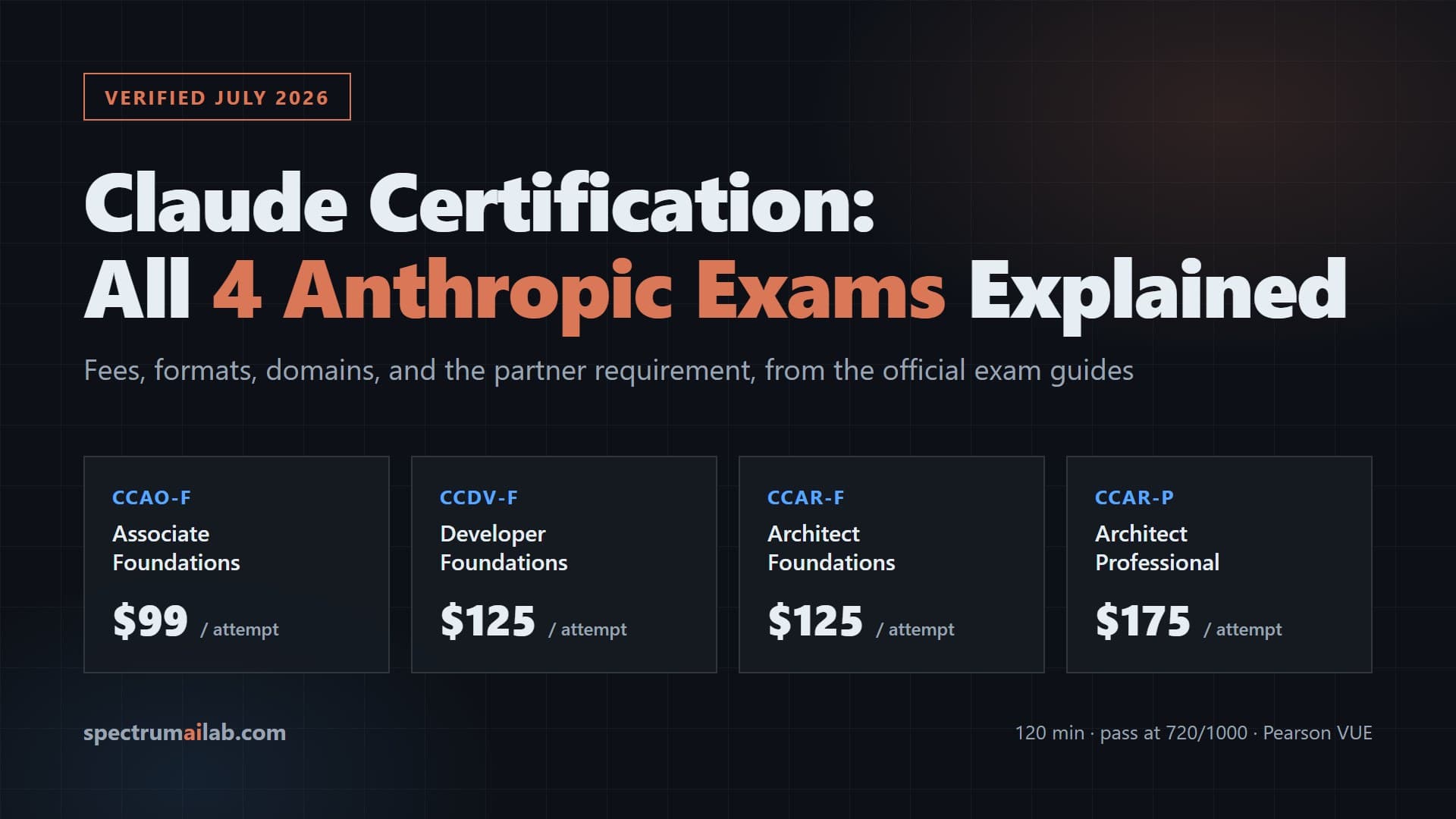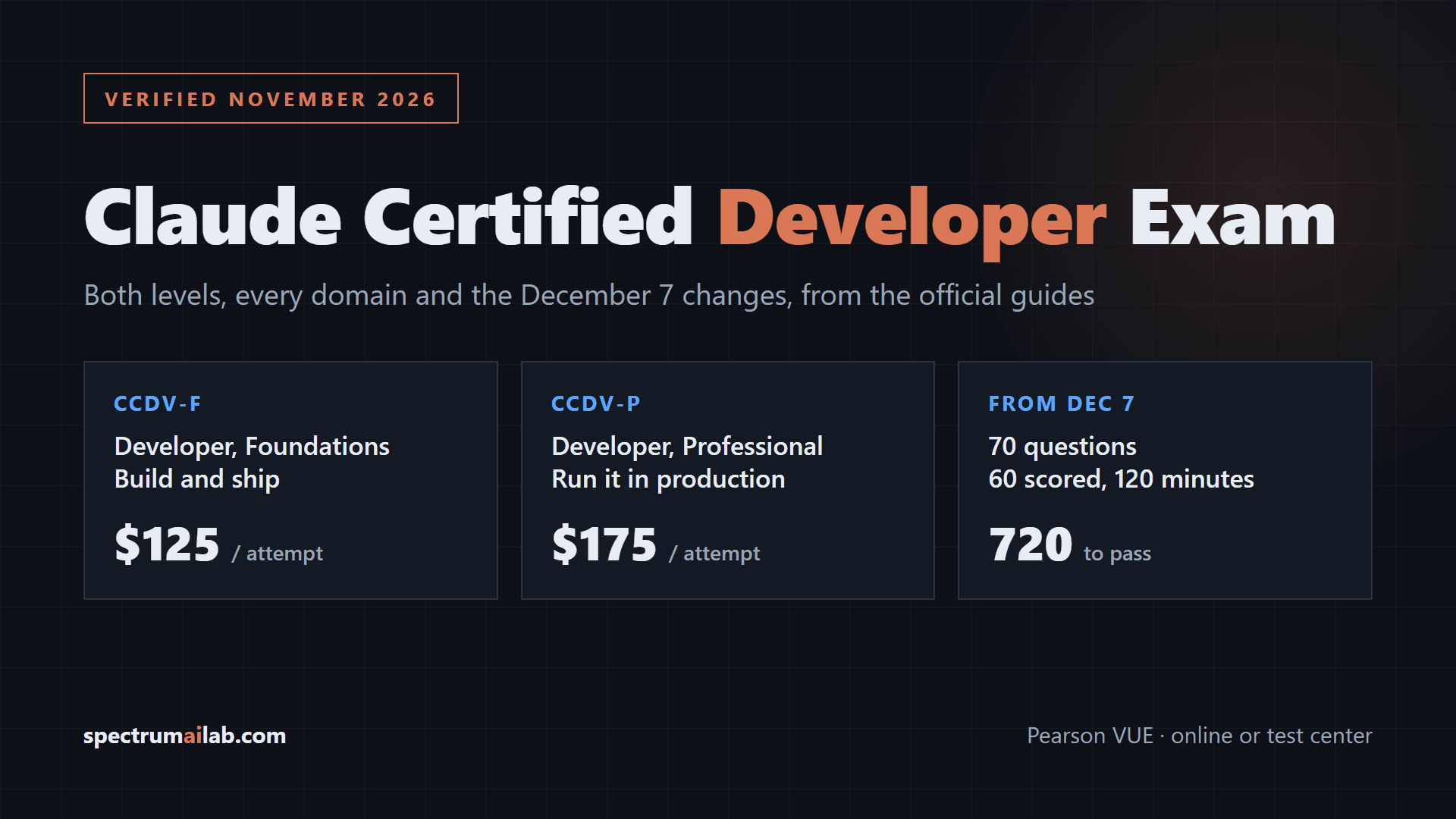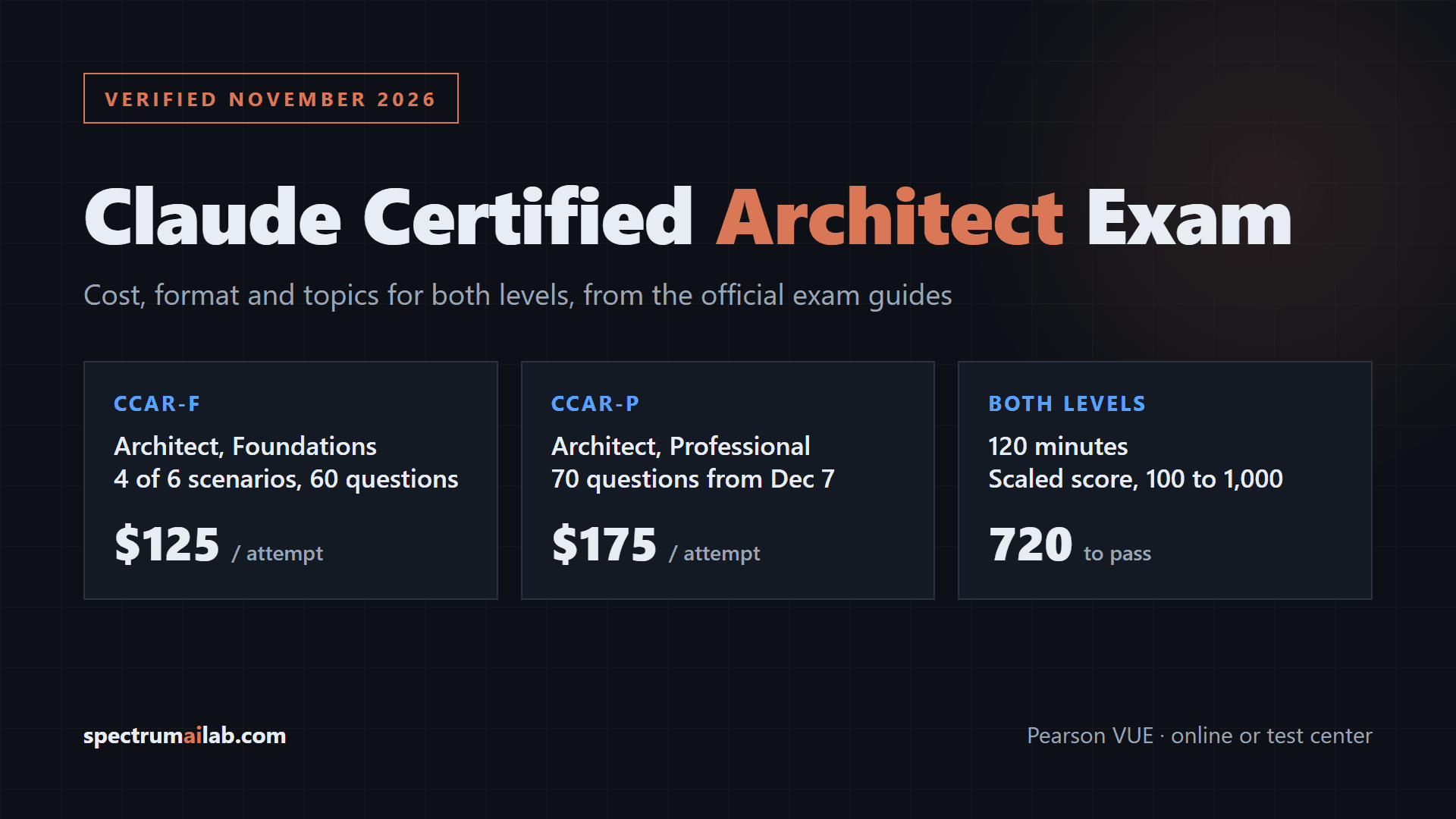
The Claude Certified Architect exam costs $125 for Foundations (CCAR-F) and $175 for Professional (CCAR-P) per attempt, before any partner discount. Older articles that say $99 for Foundations are out of date, because the price rose on June 30, 2026. Both exams allow 120 minutes and pass at 720 on a 100 to 1,000 scale. Foundations has 60 questions built on 4 production scenarios picked from a pool of 6, and its guide does not change on December 7. Professional changes that day: it goes from 63 items to 70 (60 scored) and becomes scenario based. Only people at Claude Partner Network organizations can register. The exam details below come from Anthropic's three Architect exam guides, which are the official rulebooks.
Both Architect levels at a glance
Same time limit and passing bar, different job.
Anthropic runs two Architect exams, and neither requires the other. Both are proctored by Pearson VUE, and both can be taken online or at a test center. Both start from the same core tools: the Claude API, the Claude Agent SDK (Anthropic's kit for building agents), Claude Code (its coding assistant) and MCP (the Model Context Protocol, a standard way to plug outside tools and data into Claude). Professional goes beyond them. The table uses the Professional guide effective December 7, 2026, the version most people booking now will sit. The older version is covered in the December 7 section.
Architect, Foundations vs Architect, Professional
| Architect, Foundations | Architect, Professional (from December 7) | |
|---|---|---|
| Code | CCAR-F | CCAR-P |
| Fee per attempt | $125 USD | $175 USD |
| Questions | 60 | 70 (60 scored, 10 unscored) |
| Question style | Multiple choice and multiple response | Scenario-based multiple choice; each item says how many answers to pick |
| Structure | 4 scenarios picked from a pool of 6 | Scenario-based items |
| Time limit | 120 minutes | 120 minutes |
| Passing score | 720 on a 100 to 1,000 scale | 720 on a 100 to 1,000 scale |
| Prerequisites | None listed | None (Foundations recommended) |
| Valid for | 12 months, free on-time renewal | 12 months, free on-time renewal |
| Core question | Can you make sound design calls with Claude Code, the Agent SDK, the API and MCP? | Can you own a Claude solution from design to operation, including risk and stakeholders? |
| Changes on December 7 | No | Yes |
Source: CCAR-F Exam Guide effective November 2026 and CCAR-P Exam Guide effective December 7, 2026; core questions are my summary
By my arithmetic, 120 minutes over 60 questions is 2 minutes each for Foundations, and 120 over 70 is about 1.7 minutes each for Professional. Those are not Anthropic figures. They only show that the Professional questions come faster.
- Two levels: Architect, Foundations (CCAR-F, $125) and Architect, Professional (CCAR-P, $175)
- Foundations has 60 questions built on 4 scenarios picked from a pool of 6, and its guide is not part of the December 7 update
- Professional goes from 63 items to 70 (60 scored, 10 unscored) on December 7, 2026
- Both allow 120 minutes and pass at a scaled 720 on a 100 to 1,000 range
- Architect, Foundations cost $99 until June 30, 2026, then $125
- Registration is limited to people at Claude Partner Network organizations, aged 18 or older
- Retake waits are 14, 30 and then 90 days, with up to four attempts per exam in a rolling 12 months
- Credentials last 12 months, and on-time renewal is a free, non-proctored assessment
If you want the other three Claude exams too (Associate and the two Developer exams), they are in my overview of all five Claude certifications. This guide stays on the two Architect exams.
What the Architect exam costs, and why you may see $99
Two fees, three discount levels, and a price that changed in June.
Architect, Foundations costs $125 and Architect, Professional costs $175, per attempt, in US dollars. Both guides print those fees. If an older article says $99 for Foundations, it is quoting the price from before June 30, 2026. In my overview, I note that Foundations rose from $99 to $125 on that date, the same day exam delivery moved to Pearson and badges moved to Credly. Today $99 is the price of the Associate exam, not an Architect exam.
What a partner organization pays per attempt (USD)
| Partner level | Discount | Foundations | Professional |
|---|---|---|---|
| Registered | None | $125 | $175 |
| Select and Preferred (and Global Premier after December 31) | 50% | $62.50 | $87.50 |
| Global Premier, through December 31, 2026 | 100% | $0 | $0 |
Source: Anthropic Partner Academy certification FAQ, checked November 26, 2026; the discounted prices are my arithmetic
- Retakes cost the fee again. Partner discounts apply to retakes too, so a Global Premier retake is also $0 through December 31, 2026.
- After December 31. My overview says Global Premier partners then drop to the standard 50%.
- What it adds up to: at full price, failing Foundations once and then passing costs $250, and sitting both exams once each costs $300. That is my arithmetic. Anthropic publishes only the per-attempt fees.
Both Architect exams count toward Claude Partner Network tiers, according to Anthropic's certification FAQ as of November 26. If your firm needs tier credit, either level works. For the other exams' prices, see my certification cost overview.
Which Architect level fits you
The guides describe two different careers.
Foundations is for the person who designs and builds with Claude. Professional is for the person who answers for the whole solution. The guides draw the line this way.
- Architect, Foundations: the guide pictures a solution architect who designs and builds production applications with Claude. They have at least 6 months of hands-on work across the Claude API, the Agent SDK, Claude Code and MCP. They have built agents with several agents working together, set up Claude Code for team workflows, designed MCP tool interfaces for backend systems, written prompts for reliable structured output, managed long contexts, wired Claude into CI/CD (the automated pipeline that tests and ships code), and made decisions about error handling and when to hand off to a person.
- Architect, Professional (from December 7): the guide aims it at mid to senior professionals: solution architects, AI and ML engineers, tech leads and senior software engineers. They typically have 3 or more years in systems architecture or platform engineering, plus 6 months or more with Claude in production, and a solid software engineering base. They know how the Anthropic API differs from Amazon Bedrock, Google Vertex AI and Microsoft Foundry, and they work comfortably in regulated companies with data residency and audit duties.
A simple test, and this is my suggestion rather than Anthropic's: if you build Claude features and want proof you know the main building blocks, start with Foundations. If you already advise clients or your own leadership on which cloud, which runtime and which controls a Claude system needs, Professional fits. If you mostly use Claude in the chat app, neither is the right start; see the Associate column in the comparison further down.
Architect, Foundations: how the exam is built
Sixty questions, four scenarios, five domains.
Every Foundations question hangs off a production scenario. The guide describes six scenarios. Each sitting shows 4 of them, picked at random, so two scenarios will not appear and you cannot know which. Study all six. Here is each one in my words.
The six Foundations scenarios
- 1Customer support agent: an Agent SDK agent with custom MCP tools for customers, orders and refunds. It should settle most contacts alone, with a target of 80% or more, and know when to pass a case to a person.
- 2Code generation with Claude Code: a team uses it for writing, refactoring, debugging and documentation, with custom slash commands, CLAUDE.md files (instruction files Claude Code reads automatically) and choices between planning first and just doing the work.
- 3Multi-agent research: a coordinator agent hands pieces of a topic to search, document analysis, synthesis and report-writing subagents to produce a cited report.
- 4Developer productivity: an agent that helps engineers explore unfamiliar code, using built-in tools such as Read, Write, Bash, Grep and Glob plus MCP servers.
- 5Claude Code in CI: it reviews code, writes test cases and comments on pull requests automatically, and the prompts must give useful comments without crying wolf.
- 6Structured data extraction: pulling fields out of messy documents, checking the result against JSON schemas, and coping with odd cases cleanly.
The guide weights five domains. It gives each an approximate share of the 60 questions. The question counts in the last column are my rounding of those weights, since Anthropic publishes no per-domain counts. The guide does not mention unscored items for Foundations, so I say 60 questions, not 60 scored.
CCAR-F domains
| Domain | Weight | Task statements | About this many of 60 questions |
|---|---|---|---|
| Agentic Architecture and Orchestration | 27% | 7 | 16 |
| Claude Code Configuration and Workflows | 20% | 6 | 12 |
| Prompt Engineering and Structured Output | 20% | 6 | 12 |
| Tool Design and MCP Integration | 18% | 5 | 11 |
| Context Management and Reliability | 15% | 6 | 9 |
Source: CCAR-F Exam Guide effective November 2026; question counts are my rounding
A task statement is the guide's term for one skill it tests. There are 30 in total, each with a list of things to know and things you must be able to do.
Architect, Foundations: what each domain tests
The 30 task statements, grouped in plain English.
These summaries are my paraphrase of the guide's 30 task statements, grouped by domain.
- Agentic Architecture and Orchestration (27%): how an agent loop works. Claude gets a request, may ask for a tool, you run it and hand the result back, and you repeat until Claude signals it is done. The exam wants you to read that signal, not guess from the wording of the reply. It also covers how a coordinator hands work to subagents (helper agents that each handle one piece). Subagents start with a blank memory, so everything they need must be written into their instructions. Other topics: running subagents in parallel, fixed step-by-step chains versus plans that adapt as you learn, using hooks (small pieces of code that run before or after a tool call) to force rules, handing a case to a human with a full summary, and resuming or branching saved sessions.
- Tool Design and MCP Integration (18%): writing tool descriptions that make similar tools easy to tell apart, and sending failures back with a category and a retryable flag. It separates a failed lookup from a lookup that found nothing, gives each agent only the tools its job needs, and uses the setting that makes Claude call a tool. It also covers MCP, the Model Context Protocol, the open standard Anthropic introduced on November 25, 2024, for connecting AI models to outside tools and data, as Wikipedia describes. In Claude Code that means a shared project setup versus a personal one, with secrets kept out of the repository, and choosing among Grep, Glob, Read, Write and Edit.
- Claude Code Configuration and Workflows (20%): CLAUDE.md files at user, project and folder level, and why an instruction saved only at the user level never reaches teammates. It covers splitting rules into topic files, including rules that load only when Claude edits matching file paths, and the difference between shared and personal slash commands and skills. It also asks when plan mode beats direct execution, how to steer Claude with examples, tests and interview questions, and how to run Claude Code in CI with no human at the keyboard and machine-readable output.
- Prompt Engineering and Structured Output (20%): specific review criteria instead of vague pleas to be careful, and a few well-chosen examples for ambiguous cases. It covers forcing structured output through tool use and JSON schemas, which fixes the format but not the meaning. It covers schema design that lets a field stay empty so Claude does not invent a value, validate-and-retry loops, and knowing when a retry cannot help because the information is simply missing. It also covers using the Message Batches API for work that can wait, and reviewing large changes in several passes.
- Context Management and Reliability (15%): keeping key facts alive in long conversations, trimming bulky tool results, and the habit of models to overlook the middle of long inputs. It covers when to escalate to a human and when to resolve alone, why mood and self-reported confidence are weak signals, and how errors should travel between agents with enough detail to recover. It covers exploring large codebases without running out of room, using notes files and subagents. Last, it covers routing uncertain results to human reviewers, and keeping track of which source said what, including conflicting numbers and dates.
The theme running through all five: when a rule matters, enforce it in code, not in the prompt. Hooks, schemas and clear tool descriptions beat polite instructions almost every time.
What is in and out of scope for Foundations
The guide's appendix tells you what to skip.
Near its end, the Foundations guide has a three-part appendix, and it is the most useful page for planning your study. Each list carries a different level of certainty, so I keep them apart.
The three appendix lists in the CCAR-F guide
| The guide's wording | What it covers, in my summary |
|---|---|
| Technologies and concepts that might appear | The Agent SDK (agent definitions, loops, stop reasons, hooks, spawning subagents). MCP (servers, tools, resources, the error flag, project configuration). Claude Code features and commands. The Claude Code command line flags for CI. The Claude API (tool use, tool choice, stop reasons, max tokens, system prompts). The Message Batches API. JSON Schema and Pydantic. The built-in tools. Few-shot prompting (showing Claude a few examples), prompt chaining, context and session management, and confidence scoring. |
| Topics explicitly tested | Agent loop control, multi-agent orchestration and subagent context, tool interface and MCP design, error handling and escalation, CLAUDE.md and rules, commands, skills and plan mode, iterative refinement, structured output and few-shot prompting, batch processing, context handling, human review workflows and information provenance. In short, the 30 task statements. |
| Topics that will not appear | See the list below. |
Source: CCAR-F Exam Guide effective November 2026, Section 17 (Appendix); my grouping of its lists
The fixed out-of-scope list is the part that saves time. The guide says these related topics will not appear:
- Building models: fine-tuning Claude or training custom models, Claude's internal design, training and weights, Constitutional AI, RLHF and other safety training methods, and embedding models or vector database details.
- Account and platform plumbing: API authentication, billing and account management, OAuth, API key rotation and other authentication details, rate limits, quotas and pricing calculations, and specific cloud provider setups on AWS, GCP or Azure.
- Hosting: deploying or running MCP servers, including the infrastructure behind them, and detailed programming language or framework work beyond what tool and schema configuration needs.
- Other Claude features: computer use, vision, the streaming API and server-sent events, prompt caching details beyond knowing it exists, and token counting or tokenization specifics.
- Measuring models: performance benchmarking and model comparison metrics.
Two readings of that list are mine, not Anthropic's. First, streaming and prompt caching details are tested on the Developer exam, as my Developer exam guide explains, so skip them when you study for this one. Second, my overview lists Bedrock and Google Cloud courses as supporting material for this exam, yet cloud provider setup is out of scope, so read those courses for context rather than configuration details.
What the 12 Foundations sample questions teach
Twelve questions, five lessons.
The Foundations guide includes 12 sample questions with the right answers and explanations, three for each of four scenarios. The guide says they are drawn from the practice test. I do not treat a practice test as available to you (see How to prepare). I describe what they teach rather than reprinting them, so read the full versions in the guide.
Preparing for the Architect exam? Practice with a real Claude Code setup.
Five lessons from the Foundations samples
- 1Enforce critical steps in code, not in prompts. In the customer support samples, an agent sometimes skips the identity check before touching orders. Stronger wording and extra examples only reduce the problem. A programmatic gate that blocks the later tool calls until the check passes removes it, because a missing step with money involved cannot be left to the model's judgment.
- 2Reach for the smallest fix that hits the real cause. When the agent picks the wrong tool, the first move is a better description, since that is what the model reads when it chooses. When it escalates the wrong cases, the answer is clear criteria with examples, not a sentiment detector, a confidence score or a separate classifier. Bigger machinery comes later.
- 3The root cause is often upstream, and failures should carry detail. In the research samples, every subagent did its job and the report still missed whole topics, because the coordinator had split the topic too narrowly. When a search times out, the coordinator should get the failure type, what was tried, partial results and alternatives, not a vague status or a hidden failure. A narrow tool for common simple checks beats routing everything through the coordinator.
- 4Put the right setting in the right place. Shared slash commands live in the project's commands folder, so the whole team gets them. Big multi-file restructuring calls for plan mode first. Conventions that apply to test files scattered across the codebase belong in rule files with path patterns, which a folder-bound CLAUDE.md cannot do.
- 5Match the method to the job. In CI, run Claude Code in non-interactive mode so it never waits for a person. Use the batch API, which is cheaper but has no speed promise, only for work that can wait, such as an overnight report, never for a check developers sit waiting on. Split a big review into one pass per file plus a separate pass for how the files interact.
All five reward the same instinct: find the cause, then pick the cheapest fix that removes it for good. If you can say why each wrong option in the guide fails, you are thinking the way the exam is written.
Architect, Professional: what it tests
Seven domains, from design choices to handing the system over.
Professional assumes you already know the Foundations scope. The guide says so directly, and then moves up a level to whole solutions: where to run them, how to connect them, how to prove they work, how to keep them safe and how to explain the choices. I use the December 7 guide here. Both Professional guides call themselves version 1.1, so tell them apart by the effective date on the first page.
CCAR-P domains for exams from December 7, 2026
| Domain | Weight | Named skills | About this many of 60 scored questions |
|---|---|---|---|
| Integration | 21% | 8 | 13 |
| Solution Design and Architecture | 18% | 6 | 11 |
| Evaluation, Testing, and Optimization | 17% | 7 | 10 |
| Governance, Safety, and Risk Management | 16% | 6 | 10 |
| Claude Models, Prompting, and Context Engineering | 13% | 6 | 8 |
| Developer Productivity and Operational Enablement | 8% | 3 | 5 |
| Stakeholder Communication and Lifecycle Management | 7% | 3 | 4 |
Source: CCAR-P Exam Guide effective December 7, 2026 (weights); skill counts are my count; question counts are my rounding of each weight, which is why they add to 61 rather than 60
Here is what each domain asks, in plain words. Each summary is my paraphrase of the skills the guide names, and the guide words nearly every skill as judging an example: a design, a log, a config or an eval result (an eval is a test that scores a model's answers).
- Integration (21%): cutting an agent's tools down to what its job needs (least privilege), and spotting where credentials could leak or privileges could creep upward. It covers fixing the one limit that actually holds a system back, such as accuracy or speed, at the least cost to the other, and spotting monitoring gaps that let a failure go unnoticed. Retrieval design: RAG (retrieval-augmented generation, where relevant passages are fetched first and given to Claude), search done by an agent with tools, or putting the whole corpus in context. It also covers choosing between MCP, direct API or command line calls, and agent-to-agent handoff, loading context step by step instead of all at once, and reliability controls such as rate limit handling, retries, fallbacks and idempotency (making a repeated request have the same effect as one request, so a retry cannot pay twice).
- Solution Design and Architecture (18%): deciding what Claude does, what people keep and what is shared, judged by how reversible the work is, the stakes and who is accountable. It covers judging a whole design for scale, upkeep and access control, and finding the part that breaks first. It covers choosing between a fixed workflow, an agent, an augmented-LLM setup or a Skills-based pattern, and checking how work is split between an orchestrator and subagents. It also covers picking the option with the best measurable business result under a cost or SLA ceiling (an SLA is a promised level of speed or uptime), and choosing a deployment surface (Anthropic API, Amazon Bedrock, Google Vertex AI or Microsoft Foundry) and an agent runtime (your own loop, the Agent SDK or headless Claude Code you host, or Claude Managed Agents) under residency, compliance and ownership limits, with the tradeoffs spelled out.
- Evaluation, Testing, and Optimization (17%): finding what a failed release's eval suite never measured, building evals from a business process, and fixing an LLM judge (a model grading another model) that disagrees with people, whether from favoring the first answer, long answers, its own style or drift. It covers designing a fair comparison of two prompt or model setups, including how many trials per test case separate a real effect from run-to-run noise. It covers tracing a failing system to prompt, retrieval, hallucination, tool or model mismatch, and cutting cost and delay using telemetry such as cache hit rates. It also covers model version migration: stay on (pin) the current version, retune prompts, rebuild the baseline or wait, given a retirement date and test results.
- Governance, Safety, and Risk Management (16%): placing guardrails so they close a misuse path without breaking legitimate use, defending against prompt injection (planted text that tricks a model into obeying it) when Claude reads documents, tool results, MCP responses or third-party Skills, and ranking risks such as attack surface, failure modes, running out of tokens or quota, and supply chain. It covers where human approval gates belong in a workflow with irreversible steps, and picking architecture controls that evidence a compliance duty: data residency (where data is processed), zero data retention (the provider does not keep prompts and outputs), personal data detection and redaction, audit logs and tenant isolation. It also covers working out whether uneven results come from the data, the prompt framing or the way the evaluation was built.
- Claude Models, Prompting, and Context Engineering (13%): picking a model tier that fits every latency, cost and quality limit, and fixing vague system prompts without over-constraining them. It covers choosing between zero-shot (no examples), few-shot (a few examples), prompted reasoning, native thinking and structured output without wasting tokens, working out where tokens go across a given call volume, and ordering a prompt so stable content comes before changing content, to make caching work. It also covers setting reasoning effort and choosing how a long-running agent keeps its context healthy: editing the context, a memory tool or compaction.
- Developer Productivity and Operational Enablement (8%): packaging a Claude Code workflow that worked for one team so a whole organization can use it, through plugins (bundles of skills, hooks, subagents, commands and MCP settings), a marketplace and managed settings, and deciding what is enforced centrally. It covers configuring Claude Code or the Agent SDK, including permission modes (default, acceptEdits, plan, auto, dontAsk and bypassPermissions), hooks, subagent definitions and headless runs. It also covers keeping human ownership of AI-generated code through review and accountability controls.
- Stakeholder Communication and Lifecycle Management (7%): catching a promise, in discovery notes or in a draft SLA, that the proposed design cannot keep, and reviewing an ADR (architecture decision record, a short written record of a design choice, its tradeoffs and leftover risk) so it states the risk without overstating how predictable the model is. It also covers checking a handoff package for the missing assumption, dependency or runbook step that would block the team taking over.
The unusual part of this exam is how it asks. The guide warns that exam scenarios show you things other people made, such as architecture diagrams, config files, logs, eval results and code, and you must work out the answer from them. If you only know definitions, you will struggle.
What changes on December 7, 2026
Professional gets 70 items, scenario questions and a new weight balance.
Of the two Architect exams, only Professional changes on December 7. Foundations does not. Pearson VUE's Anthropic page lists Architect Professional among the exams updated that day, not Architect Foundations, and says the updated guides became available on November 17. The date you sit the exam decides the version.
CCAR-P: through December 6 vs from December 7
| Through December 6 | December 7 or later | |
|---|---|---|
| Items | 63 | 70 (60 scored, 10 unscored) |
| Item style | Multiple choice and multiple response | Scenario-based multiple choice; each item still says how many answers to pick |
| Integration | 19% | 21% |
| Solution Design and Architecture | 17% | 18% |
| Evaluation, Testing, and Optimization | 16% | 17% |
| Governance, Safety, and Risk Management | 14% | 16% |
| Claude Models, Prompting, and Context Engineering | 13% | 13% |
| Developer Productivity and Operational Enablement | 7% | 8% |
| Stakeholder Communication and Lifecycle Management | 14% | 7% |
| Fee, time limit, passing score | $175, 120 minutes, 720 | Unchanged |
Source: CCAR-P Exam Guides effective November 2026 and December 7, 2026
Beyond the numbers, a side-by-side read of the two guides shows these differences:
- Task bullets became skill descriptions. The November guide lists short tasks such as selecting a model or designing a RAG pipeline. The December 7 guide gives each skill a name and a full sentence on the situation and the judgment it expects, which fits an exam built on reading examples.
- Deployment surfaces and a runtime are named. The new guide names the Anthropic API, Amazon Bedrock, Google Vertex AI and Microsoft Foundry, and Claude Managed Agents. The November guide names none of them.
- Claude Code gets specific. The new guide names Claude Code permission modes and plugin distribution. The November guide only mentions configuring Claude tools for teams, with Claude Code as an example.
- New skills appear. The December 7 guide adds idempotency for retried tools that have side effects, experiment design with trials per case, model version migration, tracing bias to its source, accountability for AI-generated code, architecture decision records and checking a handoff package for gaps. The November guide mentions handoff only as a lifecycle phase, and it names bias only as an ethics topic.
- The stakeholder domain shrinks. Its weight halves, and it is now three skills about commitments, decision records and handoffs.
- The candidate sections changed. The November guide had a separate minimally qualified candidate section and a list of people the exam is not intended for. The new guide has neither. The audience also tightened: the old guide asked for six months with Claude or comparable LLM systems in production, and the new one asks for six months with Claude in production.
- Some names are no longer named. The November guide named GDPR, HIPAA and FedRAMP, ethics and fairness topics, chain-of-thought prompting and A/B testing. The new guide no longer names those. It still tests compliance controls and bias, so that does not mean the ideas cannot come up.
If you test before December 7
If your exam is on or before December 6, you sit the 63-item version, and the November guide is the one to study. Its heaviest domain is Integration at 19%, and Stakeholder Communication and Lifecycle Management is worth a full 14%, twice what it is worth after December 7.
What the 3 Professional samples teach
The binding constraint, the retry and the gate.
The December 7 Professional guide has three sample items with answers and rationale. The guide says they are not taken from the real question pool. I describe each in my words.
The three Professional samples, summarized
- 1Residency decides the surface (Solution Design): a financial firm must keep all model input inside its own cloud boundary, while the product team wants the newest features and the platform team wants Anthropic to host the agent loop. The residency duty is the hard constraint, so the answer is the firm's cloud marketplace surface, and the firm accepts the tradeoffs: features arrive later, and it owns the agent runtime and session state. Zero data retention only limits how long the provider keeps data. It does not move the processing inside the firm's boundary, so it cannot stand in for residency.
- 2Retried payments paid twice (Integration): during a traffic surge, the client retried every failed call, and some payments had already gone through before the client timed out. The fix is an idempotency key, which lets the payments tool recognize a repeat and return the first result. Longer timeouts only make the double payment rarer, and a prompt instruction cannot help because the retry happens in code the model never sees.
- 3Approval gates where they matter (Governance): a team put a human approval before every step of an account-change agent, so requests waited hours. The better design gates only the step with an immediate, irreversible charge, and handles the safe or reversible steps with tight constraints and an audit log. A confidence threshold is not a reliable gate for a step that cannot be undone.
The three share one rule: pick the control by what cannot be undone and what is fixed by law or contract, then name the tradeoff you accept. That is what the guide means when it says a skill involves justifying the choice.
Architect, Developer or Associate?
Three tracks, three different jobs.
People weighing Architect usually compare it with the Developer exam, and some with Associate. They overlap on agents, Claude Code and MCP, but the questions are written for different jobs. My Developer exam guide has the full breakdown of that track.
Associate vs Developer vs Architect
| Associate | Developer | Architect | |
|---|---|---|---|
| Levels | Foundations only | Foundations and Professional | Foundations and Professional |
| Fee | $99 | $125 and $175 | $125 and $175 |
| Aimed at | Business users of Claude, such as operations, marketing and HR | Engineers who build Claude features and run them in production | Solution architects who design Claude systems and, at Professional, own delivery and governance |
| Foundations format | 60 items through December 6, 70 (60 scored) from December 7 | 53 items through December 6, 70 (60 scored) from December 7 | 60 items, 4 scenarios from a pool of 6, no change |
| Professional format | None | 70 items (60 scored), no change | 63 items through December 6, 70 (60 scored) from December 7 |
| Counts toward partner tier | No | Yes | Yes |
Source: Claude Certified Architect exam guides; Associate and Developer columns from my certification overview and Developer exam guide, checked November 26, 2026
Pick Architect when your work is the design itself: which parts a Claude system needs, how they connect and why, argued in front of clients or leadership. Pick Developer when your day goes into writing and fixing code. Both earn partner tier credit. Associate does not, so check what your firm needs before you pay.
Booking, retakes and renewal
The short version. My overview has the detail.
The rules are the same across all three guides, so I keep this short. The long version, with name matching, accommodations and exam day rules, is in my certification overview.
- Who and where: you start on Anthropic Partner Academy, press Register on the exam page, confirm your exam profile and continue to Pearson. At Pearson VUE you choose online proctoring (OnVUE) or a test center, pick a slot and pay. Only people at Claude Partner Network organizations can register, with a recognized company email, at 18 or older, in a supported country or region.
- Fee: $125 or $175 per attempt, with partner discounts applied at checkout, and the same fee again for every retake, less any discount.
- Retake waits: 14 days after the first fail, 30 after the second and 90 after the third. You get at most 4 attempts per exam in a rolling 12 months, and failing one exam does not block a different one.
- Passing: 720 on a 100 to 1,000 scale. The guides call the exam criterion referenced, which means you are measured against a fixed standard rather than other test takers, as Wikipedia contrasts it with ranking tests. Your score report shows percent correct per domain, but only the total decides the result.
- Validity and renewal: a credential lasts 12 months. Renewing on time is a free, non-proctored assessment on Partner Academy. A lapsed credential means sitting the full exam again at full price. The guides add that big content changes can also require a full retake.
- Badge: when I checked on November 26, 2026, the Credly badge stayed with the person, not the firm.
One detail to plan around: the guides allow cancelling or rescheduling up to one hour before an online (OnVUE) exam and 48 hours before a test center exam, but Pearson VUE's Anthropic page says 48 hours for all. Until the two agree, plan on 48 hours. Later changes forfeit the fee.
How to prepare
Build things. The guides say what.
The Professional guide says no single course is required and no resource guarantees a pass. Both guides put their weight on hands-on practice.
What each guide tells you to practice
| Exam | Practice this |
|---|---|
| Architect, Foundations | Four exercises. One: build a tool-using support agent with several clearly described tools, structured errors, a code-enforced business rule and an escalation path. Two: set up Claude Code for a team, with CLAUDE.md, path-specific rules, an isolated skill, an MCP server with secrets from the environment, and a plan mode versus direct execution comparison. Three: build an extraction pipeline with schemas that allow empty fields, a validate-and-retry loop, varied examples, a batch run and human review routing. Four: build a coordinator with subagents that passes context explicitly, runs in parallel, survives a timeout and keeps source attribution when sources disagree. |
| Architect, Professional | Read the Foundations guide first, because its scope is assumed. Practice reviewing artifacts other people produced, such as architecture diagrams, config files, logs and traces, eval results and code, since the exam shows you such material and asks you to judge it. The guide also recommends shipping one complete Claude system to real users, covering model and deployment surface choice, prompt and context work, retrieval or tool integration, an eval suite, observability and layered guardrails. |
Source: CCAR-F Exam Guide (preparation exercises) and CCAR-P Exam Guide effective December 7, 2026 (How to Prepare); summarized in my words
There is no practice exam to buy. The Foundations guide says its sample questions were drawn from the practice test, but my overview notes that the old practice exam was retired in the move to Pearson. The 12 Foundations samples and the 3 Professional samples are the practice material in the guides, so work through every one and explain why each wrong option fails.
Free courses help with the vocabulary. When I checked Partner Academy on November 26, Foundations listed a set of topic courses, with supporting courses including AI Fluency, Claude 101, Building with the Claude API, the Bedrock and Google Cloud courses, Introduction to MCP and Claude Code in Action. Professional listed a 5-course prep path, with supporting courses including Building with the Claude API, Introduction to MCP, Model Context Protocol: Advanced Topics and the Bedrock and Google Cloud courses. The prep paths need a partner account. Public courses are free on Claude Academy, and my Claude Academy ranking says which are worth the time.
A four-week plan for Foundations, built on the weights. This is my suggestion, not Anthropic's:
- Week 1, orchestration (27%): build the agent loop, add a hook that blocks one risky action, then add a coordinator and two subagents.
- Week 2, Claude Code and prompts (40%): set up CLAUDE.md and path-specific rules, write a skill, then build the schema, retry loop and batch run.
- Week 3, tools and context (33%): write three tools with confusable descriptions and fix them, add structured errors, then practice the escalation and provenance patterns.
- Week 4, scope and samples: read the out-of-scope list again, work through all 12 samples, and drill your weakest domain.
Courses alone will not pass Professional
Professional items ask you to read a design, a trace or an eval result and decide what fails first. That judgment comes from running something real. My advice: if you have not shipped a Claude system, take Foundations first, or spend a month reviewing real artifacts before you book.
If you are still deciding whether a Claude exam is worth it next to other options, my ranking of AI certifications compares it with Google, AWS and Microsoft credentials.
Sources
Official pages first, background second.
- Anthropic: Claude Certified Architect, Foundations exam guide, effective November 2026 (PDF)
- Anthropic: Claude Certified Architect, Professional exam guide, effective November 2026, for exams through December 6 (PDF)
- Anthropic: Claude Certified Architect, Professional exam guide, effective December 7, 2026 (PDF)
- Pearson VUE: Claude Certification Program by Anthropic
- Anthropic Partner Academy, checked November 26, 2026: Architect, Foundations page, Architect, Professional page, certification FAQ, eligibility and exam prep courses
- My own posts for the other exams and the detail I left out here: certification overview and Developer exam guide
- Background from Wikipedia: Model Context Protocol and Criterion-referenced test
FAQ
How much does the Claude Certified Architect exam cost?
Architect, Foundations (CCAR-F) costs $125 USD per attempt and Architect, Professional (CCAR-P) costs $175. Each retake costs the fee again, less any partner discount. Older articles that say $99 for Architect, Foundations predate June 30, 2026, when the price went from $99 to $125. When I checked Anthropic's certification FAQ on November 26, 2026, Select, Preferred and Global Premier partners got 50% off, and Global Premier partners got 100% off through December 31, 2026.
What is the difference between Architect Foundations and Architect Professional?
Foundations tests design judgment across Claude Code, the Agent SDK, the Claude API and MCP, in 60 questions built on 4 of 6 production scenarios. Professional, in its December 7 version, tests whether you can own a whole Claude solution: choosing the deployment surface, integration and reliability, evaluation, governance and risk, and stakeholder work. It has 70 scenario-based questions, of which 60 are scored, and its guide aims it at mid to senior professionals with 3 or more years in systems architecture or platform engineering.
What changes on the Architect exam on December 7, 2026?
Only Architect, Professional changes. It goes from 63 items to 70 (60 scored, 10 unscored) and every item becomes scenario based. Stakeholder Communication and Lifecycle Management drops from 14% to 7%, while Integration rises from 19% to 21%. The fee, the 120 minutes and the 720 passing score stay the same. Architect, Foundations is not part of the update.
Do I need Architect Foundations before Architect Professional?
No. Neither Architect exam requires the other. From December 7, the Professional guide recommends Foundations without requiring it and treats the Foundations scope as assumed knowledge. The November Professional guide does not mention Foundations. The Foundations guide lists no prerequisites and describes a typical candidate with 6 or more months of hands-on experience.
Should I take the Claude Certified Architect, Developer or Associate exam?
Take Architect if your job is deciding how a Claude system should be designed and defending that design. Take Developer if you write the code: API calls, tools, evals and Claude Code setups. Take Associate, Foundations ($99) if you use Claude for business work rather than building with it. Architect and Developer both cost $125 at Foundations level and $175 at Professional level, and both count toward partner tiers.
How long is the Architect credential valid and how does renewal work?
A credential lasts 12 months after the day it is awarded. Renewing on time means reviewing what changed and passing a free, non-proctored assessment on Anthropic Partner Academy. If the credential lapses, you must sit the whole exam again at full price, and the guides say Anthropic may require a full retake if exam content changes significantly.
Can anyone take the Claude Certified Architect exam?
No. Only staff of firms in the Claude Partner Network can register. Your work email must sit on a domain in your firm's partner record, you must be 18 or older, and your country or region must be one Anthropic supports. Firms can join for free. I checked these rules on Anthropic Partner Academy on November 26, 2026.
How do I book the Claude Certified Architect exam through Pearson VUE?
Start on Anthropic Partner Academy, open the Architect exam page, press Register, confirm your exam profile and continue to Pearson. At Pearson VUE you pick online proctoring or a test center, book a slot and pay, and any partner discount is already in the price. The guides allow cancelling up to one hour before an online exam and 48 hours before a test center exam, but Pearson's page says 48 hours for all, so plan on 48 hours.

Founder of Spectrum AI Labs, testing AI tools and models, and writing up what actually ships.
More about Paras →Stay ahead of the AI curve
We test new AI tools every week and share honest results. Join our newsletter.